Differentiation looks intimidating the first time you meet it, but it is one of the most rewarding topics in O-Level Additional Mathematics. The rules are fixed, the question types repeat every year, and once you can recognise which tool to reach for, the marks come quickly. Here is how our students go from lost to fluent.
Start with the four rules you cannot skip
Everything in differentiation builds on a small set of rules. Know these cold before anything else:
- Power rule for terms like x to the n
- Chain rule for a function inside a function, such as (2x + 1) raised to a power
- Product rule when two functions are multiplied
- Quotient rule when one function is divided by another
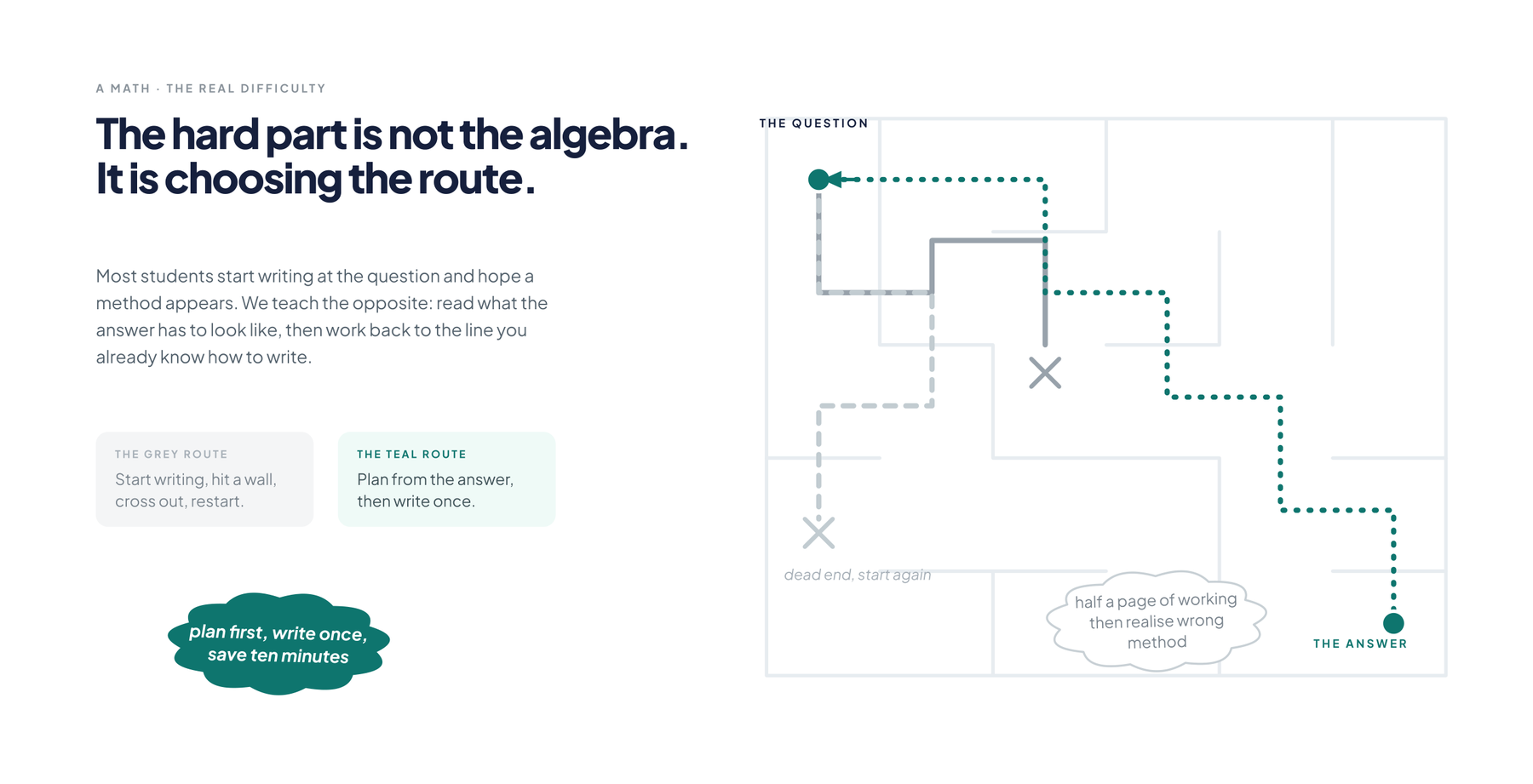
The exam does not tell you which to use. Your job is to look at the structure of the expression and decide. That recognition is the real skill, and it comes from practice, not from rereading notes.
Learn to spot the question type
Most A Math differentiation questions are one of a handful of shapes:
- Find the gradient at a point. Differentiate, then substitute the x value.
- Find the equation of a tangent or normal. Gradient of the tangent is dy/dx. Gradient of the normal is the negative reciprocal. Do not mix them up, this is a common lost mark.
- Stationary points and their nature. Set dy/dx to zero, solve, then use the second derivative to decide maximum or minimum.
- Rates of change and connected rates. These use the chain rule to link two changing quantities.
- Maximum and minimum problems. Build the expression, differentiate, set to zero, and always check it is the maximum or minimum the question asked for.
When you can name the type in the first ten seconds, you have already done half the thinking.
The slip-ups that cost the most
- Forgetting the chain rule. Differentiating (3x + 2) squared as if the inside were just x loses marks instantly. The inside function needs its own derivative multiplied in.
- Sign errors on the normal. The normal gradient is the negative reciprocal, not just the negative.
- Stopping too early. If a question asks for the nature of a stationary point, finding it is not enough. You must test it and state maximum or minimum with a reason.
- Not checking against the context. In a maximum-volume problem, a negative length is not a valid answer. Sanity-check the number.
Build speed with timed sets
Fluency in differentiation is about pattern recognition under time pressure. The best way to build it is short, timed sets of mixed question types, so you practise choosing the right rule rather than grinding the same one. Do ten mixed questions in twenty minutes, mark them honestly, and note which type slowed you down.
The hardest O-Level subject, simplified
A Math has a reputation as the toughest O-Level subject, and differentiation is where a lot of students decide it is too hard. It is not. It is a small set of rules applied to repeating patterns. In a Dojo A Math class, you drill those patterns with a tutor who recently sat the same paper, and you get marked the way Cambridge marks, so the slip-ups get caught before the exam does.
Want to see how it works? Book a 1-to-1 trial and a tutor will go through your latest paper with you.