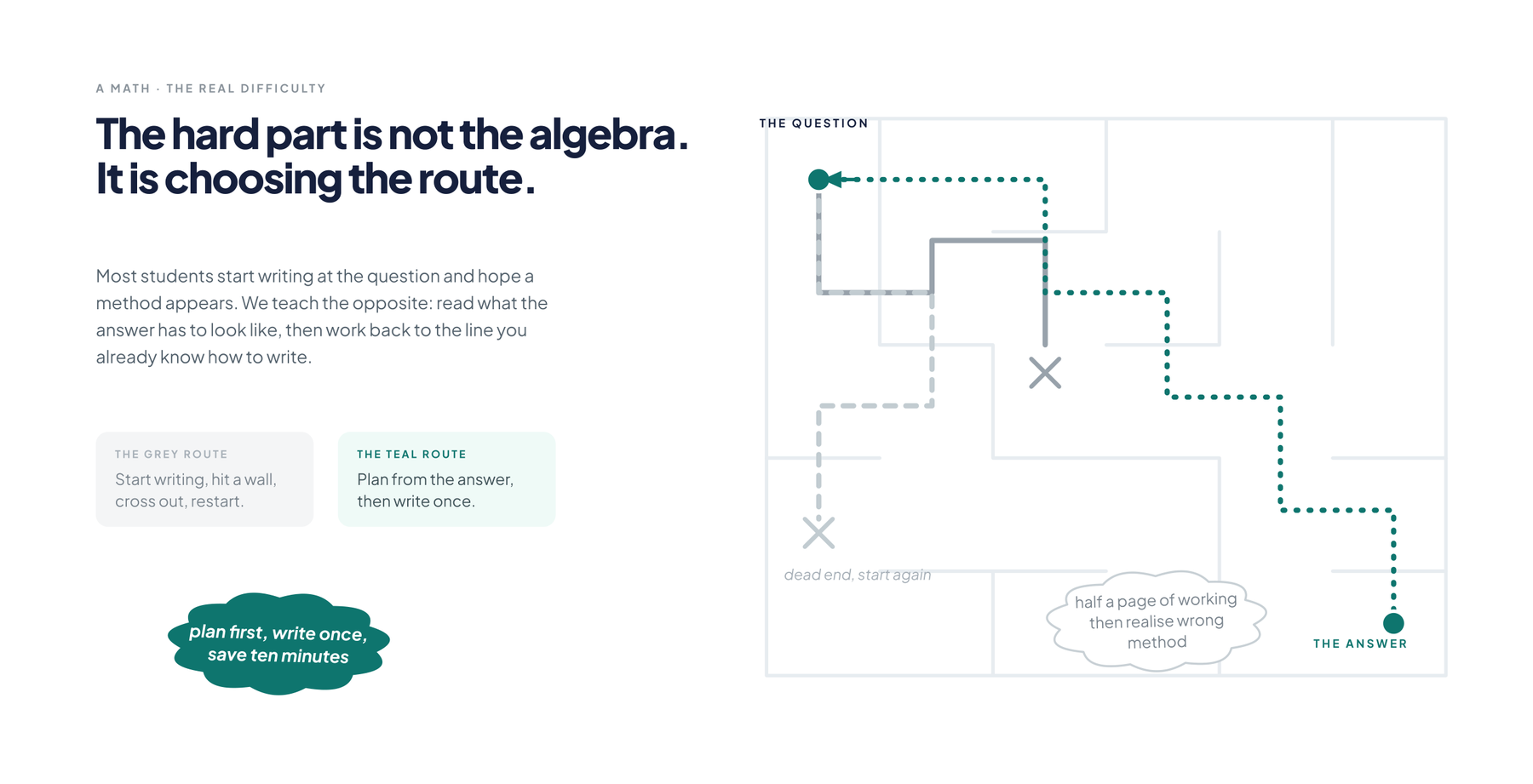
Logarithms and exponentials show up in almost every O-Level Additional Mathematics paper, usually as a 4 to 6 mark question in Paper 1 or Paper 2, and often again inside a longer question on curve sketching or kinematics. The good news is that this topic is highly patterned. Once you can recognise which of five question types you are looking at, the method almost writes itself.
The rules you must know cold
Everything in this topic comes from a single definition on the MOE syllabus:
If a^x = b, then log_a b = x, where a > 0, a is not 1, and b > 0.
From that definition come the laws you will use every single time:
- log_a (xy) = log_a x + log_a y
- log_a (x/y) = log_a x minus log_a y
- log_a (x^n) = n log_a x
- log_a a = 1 and log_a 1 = 0
- Change of base: log_a b = (lg b) / (lg a), or (ln b) / (ln a)
Write these on a card and recite them until you can produce all five in under thirty seconds. Students who fumble the laws lose marks not because the question was hard, but because they spent four minutes rebuilding a rule they should have known instantly.
Type 1: Same base, compare indices
If you can force both sides into the same base, you can equate the powers.
Example: solve 4^(x+1) = 8^(x-2).
Write both sides in base 2: 2^(2x+2) = 2^(3x-6). Equate indices: 2x + 2 = 3x minus 6, so x = 8.
Look for this whenever the numbers are powers of 2, 3, 5 or 10. It is always faster and cleaner than taking logs.
Type 2: Take logarithms on both sides
When the bases cannot be matched, take lg of both sides and use law 3 to bring the power down.
Example: solve 3^x = 20.
Take lg: x lg 3 = lg 20, so x = lg 20 / lg 3 = 2.727 (3 s.f.).
A harder version: 5^(2x) = 7^(x+1). Taking lg gives 2x lg 5 = (x + 1) lg 7. Expand, collect the x terms on one side, factorise, then divide. Treat lg 5 and lg 7 as ordinary constants and the algebra becomes routine.
Type 3: Quadratic in disguise
This is the type most likely to appear for 5 marks.
Example: solve 2^(2x) minus 5(2^x) + 4 = 0.
Let y = 2^x. The equation becomes y^2 minus 5y + 4 = 0, so y = 1 or y = 4. Substituting back, 2^x = 1 gives x = 0, and 2^x = 4 gives x = 2.
The same trick works for logs. In (log_3 x)^2 minus 3 log_3 x + 2 = 0, let u = log_3 x, solve for u, then convert back with x = 3^u.
Warning: if your substitution gives a negative value of y, reject it. An expression like 2^x can never be negative or zero, and the mark scheme awards a mark for stating that the negative root is rejected.
Type 4: Combine logs into a single logarithm
Example: solve log_2 (x + 3) + log_2 (x) = 2.
Combine: log_2 (x(x+3)) = 2. Convert to index form: x^2 + 3x = 4, so x^2 + 3x minus 4 = 0, giving x = 1 or x = minus 4.
Now check the domain. Substituting x = minus 4 gives log_2 (minus 4), which is undefined, so reject it. The answer is x = 1. Domain checking is the single most commonly dropped mark in this whole topic.
Type 5: Simultaneous equations
Example: log_2 x + log_2 y = 5 and x minus y = 6. Combine the logs to get xy = 32, substitute x = y + 6, solve the quadratic, then reject any solution that makes a logarithm undefined.
Mark-scheme habits that protect your marks
- Show the law you used. Writing "log a + log b = log ab" earns method marks even if the arithmetic later slips.
- Keep exact values until the final line, then round to 3 significant figures unless told otherwise.
- State rejections explicitly: "reject x = minus 4 since log is undefined for negative values".
- Do not write lg without a base if you started with ln. Stay consistent throughout.
Common mistakes to stop making today
- Writing log(x + y) as log x + log y. This is wrong and it is tested deliberately.
- Writing (log x)^2 as 2 log x. Only log(x^2) equals 2 log x.
- Forgetting that log_a a = 1, which turns many messy expressions into simple ones.
- Dividing both sides by an exponential term and losing a solution.
A two-week practice plan
Spend ten minutes a day for a week doing five questions, one of each type above, from your Ten Year Series. In the second week, mix them randomly so you practise recognising the type rather than repeating a method. Recognition speed is what separates a B3 from an A1 under exam pressure.
If you want a tutor who sat these exact papers recently to walk you through the harder substitution questions live, message us to book a 1-to-1 trial on WhatsApp.