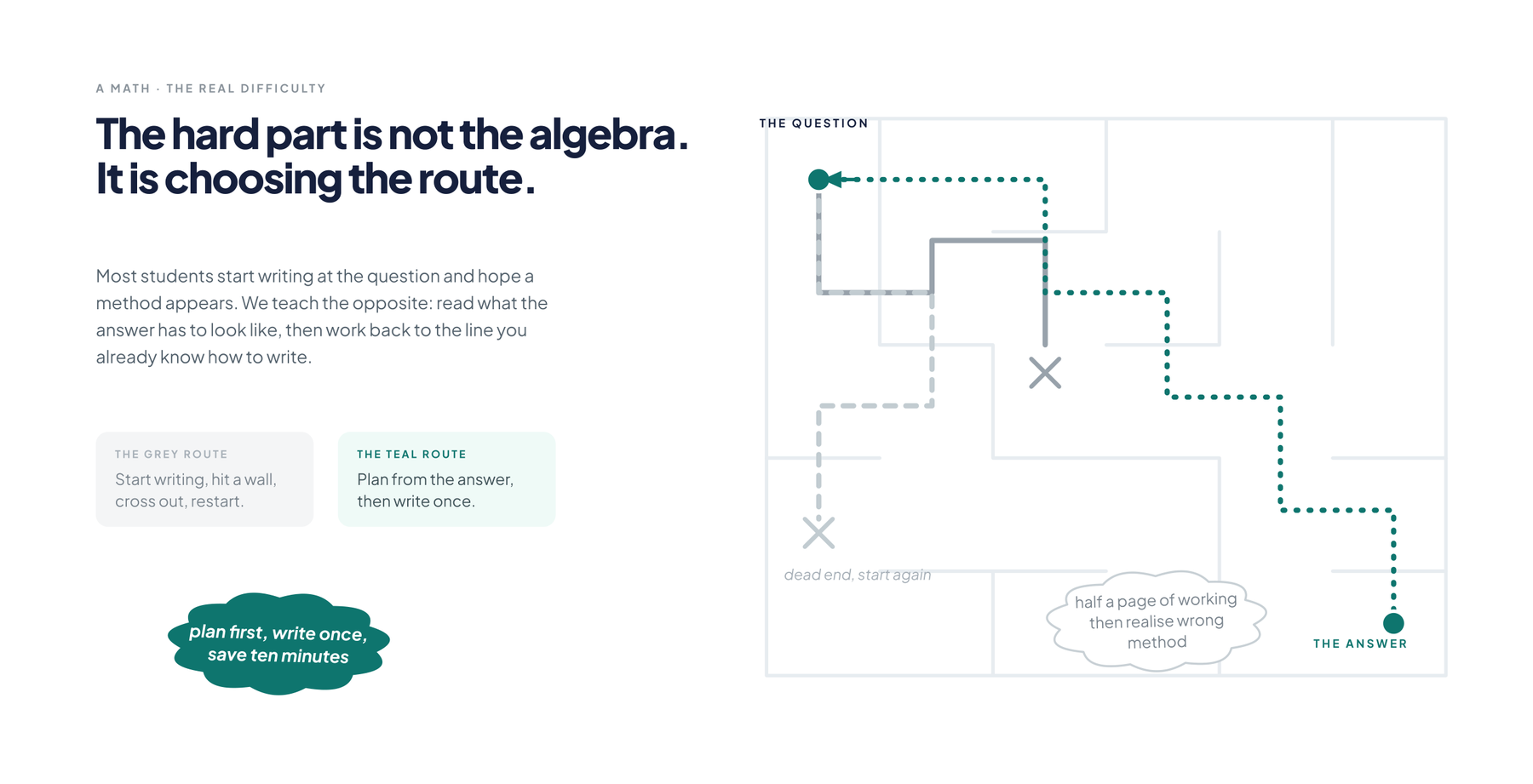
Proving trigonometric identities is one of those A Math questions that looks intimidating and is actually one of the most predictable parts of Paper 1 and Paper 2. There is no hidden trick. There is a toolkit, a method, and a way of writing your working that examiners are looking for. Once you have all three, "prove that..." questions become free marks.
Here is the exact approach our tutors used when we sat these papers.
First, memorise the toolkit
You cannot prove an identity if you do not know the identities. From the Singapore-Cambridge O-Level Additional Mathematics syllabus, these must be automatic:
Reciprocal and quotient:
- $\tan\theta = \dfrac{\sin\theta}{\cos\theta}$, $\cot\theta = \dfrac{\cos\theta}{\sin\theta}$
- $\csc\theta = \dfrac{1}{\sin\theta}$, $\sec\theta = \dfrac{1}{\cos\theta}$
Pythagorean:
- $\sin^2\theta + \cos^2\theta = 1$
- $1 + \tan^2\theta = \sec^2\theta$
- $1 + \cot^2\theta = \csc^2\theta$
Compound and double angle (given in the formula list, but know them cold):
- $\sin(A \pm B)$, $\cos(A \pm B)$, $\tan(A \pm B)$
- $\sin 2A = 2\sin A\cos A$
- $\cos 2A = \cos^2 A - \sin^2 A = 2\cos^2 A - 1 = 1 - 2\sin^2 A$
- $\tan 2A = \dfrac{2\tan A}{1 - \tan^2 A}$
Notice that $\cos 2A$ has three forms. Choosing the right one is usually the whole question.
The five-step method
Step 1: Start with the messier side
Almost always the left-hand side, but not by rule. Pick the side with more terms, more fractions, or more different trigonometric functions. You are simplifying towards the cleaner side, not building complexity.
Step 2: Convert everything into sine and cosine
This single move solves maybe half of all identity questions. Secant, cosecant, cotangent and tangent all become sine and cosine, and suddenly you can combine fractions.
Step 3: Combine into a single fraction
Common denominator, expand the numerator, tidy up. Fractions hide the structure. One fraction reveals it.
Step 4: Hunt for $\sin^2 + \cos^2 = 1$
Any time you see $1 - \cos^2\theta$, $1 - \sin^2\theta$, or a $\sin^2 + \cos^2$ pair, substitute immediately. Also watch for the difference of two squares, $(1 + \cos\theta)(1 - \cos\theta) = \sin^2\theta$.
Step 5: Stop when you reach the other side, and say so
Write the final line as $= \text{RHS}$ followed by "(shown)" or "(proved)". Examiners want to see the argument closed.
Worked example 1: convert and combine
Prove that $\dfrac{1}{1+\cos\theta} + \dfrac{1}{1-\cos\theta} = 2\csc^2\theta$.
$$\text{LHS} = \frac{(1-\cos\theta) + (1+\cos\theta)}{(1+\cos\theta)(1-\cos\theta)} = \frac{2}{1-\cos^2\theta} = \frac{2}{\sin^2\theta} = 2\csc^2\theta = \text{RHS (shown)}$$
Four lines. The whole question was Step 3 followed by Step 4.
Worked example 2: choosing the right $\cos 2A$
Prove that $\dfrac{1 - \cos 2A}{\sin 2A} = \tan A$.
The right-hand side involves $\tan A = \sin A / \cos A$, so we want $\sin A$ and $\cos A$ to survive. That tells us which form of $\cos 2A$ to use: the one that leaves no stray constant, namely $\cos 2A = 1 - 2\sin^2 A$.
$$\text{LHS} = \frac{1 - (1 - 2\sin^2 A)}{2\sin A\cos A} = \frac{2\sin^2 A}{2\sin A\cos A} = \frac{\sin A}{\cos A} = \tan A = \text{RHS (shown)}$$
If you had picked $\cos 2A = 2\cos^2 A - 1$, you would get $\dfrac{2 - 2\cos^2 A}{2\sin A \cos A}$, which still works after applying $1 - \cos^2 A = \sin^2 A$, just one line longer. Choosing well saves time under exam pressure.
Worked example 3: splitting a triple angle
Prove that $\sin 3A = 3\sin A - 4\sin^3 A$.
There is no triple angle formula in the syllabus, so split: $3A = 2A + A$.
$$\sin 3A = \sin 2A\cos A + \cos 2A\sin A$$ $$= (2\sin A\cos A)\cos A + (1 - 2\sin^2 A)\sin A$$ $$= 2\sin A\cos^2 A + \sin A - 2\sin^3 A$$ $$= 2\sin A(1 - \sin^2 A) + \sin A - 2\sin^3 A$$ $$= 2\sin A - 2\sin^3 A + \sin A - 2\sin^3 A = 3\sin A - 4\sin^3 A \text{ (shown)}$$
The RHS contains only sines, so we chose the $\cos 2A$ form with only sines. Let the target guide every substitution.
Mistakes that quietly lose marks
- Treating the identity as an equation. Do not cross-multiply across the equals sign or move terms from RHS to LHS. You are proving, not solving. Work one side down.
- Working both sides in a tangle. If you must work both sides, do them in two separate columns, then write "LHS = RHS" at the end. Never mix them in one chain.
- Dropping the angle. Writing $\sin^2$ instead of $\sin^2\theta$, or squaring loosely as $\sin\theta^2$. Notation errors get penalised.
- Skipping the last line. Simplifying to something equal to the RHS but never stating it. Finish the sentence.
- Giving up after 30 seconds. If Step 2 stalls, try the other side. If both stall, expand the compound angles fully and simplify from scratch.
How to practise this properly
Do ten identities in one sitting, timed, without looking at solutions. Then mark yourself on presentation as well as the answer: did you label LHS, keep one clean chain, and close with "shown"? That habit is worth more in the exam than knowing one extra formula.
If trigonometry still feels like guesswork, come and work through a few identities live with a tutor who sat this paper recently. Book a 1-to-1 trial with us on WhatsApp and bring your toughest "prove that" question along.