Most students lose marks in O-Level Chemistry not because they do not know the content, but because they do not write what the marker is looking for. Below are the test chemistry tips we give every Dojo student, drawn from sitting these exact papers ourselves and from marking hundreds of scripts since.
Know what each paper is actually testing
Pure Chemistry (6092) is split into three papers, and each one rewards a different skill.
- Paper 1 (MCQ, 30 marks): speed plus precision. Most wrong answers here come from misreading one word, such as "increases", "insoluble" or "per mole".
- Paper 2 (Structured and free response, 65 marks): phrasing. This is where mark-scheme wording earns or loses you grades.
- Paper 3 (Practical, 40 marks): procedure and observation. You cannot cram this the night before, so treat every school practical as a rehearsal.
If you are on Combined Science, the same principles apply, just with a narrower content list. Check your syllabus document rather than assuming a topic is out.
Test chemistry tips for Paper 1
Eliminate, do not guess
Almost every MCQ has two options that are clearly wrong. Cross them out physically on the paper. You then choose between two, which turns a 25 percent guess into a 50 percent one at worst.
Watch for the classic traps
- Ionic equations where students forget spectator ions are omitted.
- Graphs of reaction rate where the gradient shows rate and the plateau height shows amount of product.
- Electrolysis questions where the electrode material matters, for example copper electrodes in copper(II) sulfate solution.
- Any question with the word "only". It is usually there to make a mostly correct statement wrong.
Time yourself at 1 minute per mark
Thirty questions in about forty minutes leaves you ten minutes to revisit flagged items. Mark uncertain questions with a small dot and move on rather than stalling.
Write like the mark scheme in Paper 2
This is the single biggest score lift we see at Dojo. Chemistry marking is keyword based, so vague answers get nothing even when the idea is right.
Instead of "the reaction goes faster because the particles move more", write "at a higher temperature the particles have more kinetic energy, so there are more frequent collisions with energy greater than or equal to the activation energy".
Some phrasing habits worth drilling:
- Rate questions: always mention collision frequency and activation energy, not just "more collisions".
- Bonding and properties: name the structure, name the forces, then link to the property. For example, "giant covalent structure, strong covalent bonds throughout, so a large amount of energy is needed to break them, giving a high melting point".
- Tests for ions and gases: state the reagent, the observation and the conclusion. "Add aqueous sodium hydroxide, a light blue precipitate forms which is insoluble in excess, indicating Cu2+."
- Explain versus state: "State" needs one line. "Explain" needs a because. If your explain answer has no causal link, you have not answered it.
- Equations: balance, then add state symbols if the question shows them elsewhere. Unbalanced equations usually cap the mark.
Calculations: show the route
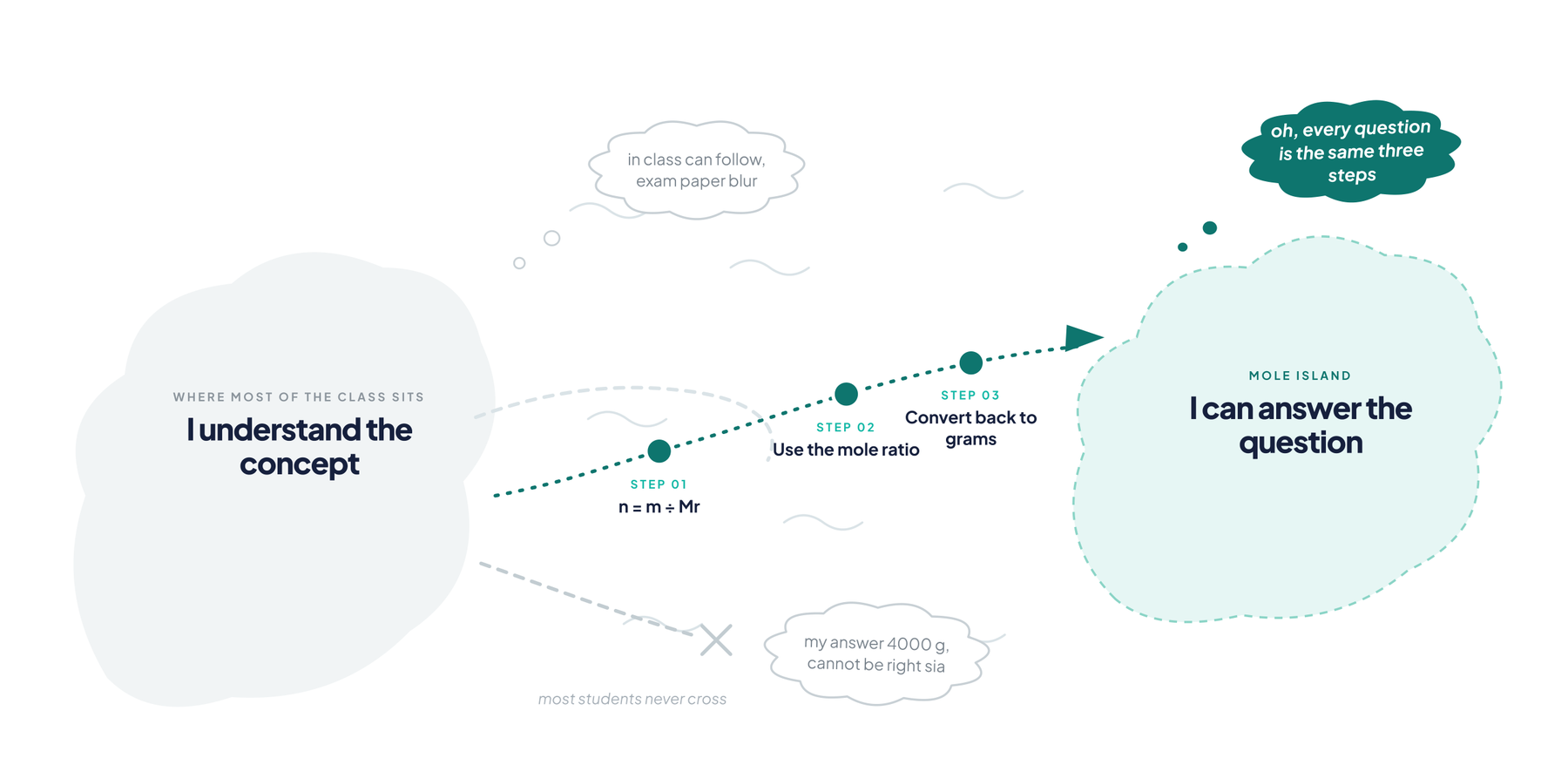
Moles questions are marked in stages, so even a wrong final answer can earn most of the marks if your working is visible. Write the sequence out:
- Moles of known substance from mass, volume or concentration.
- Mole ratio from the balanced equation.
- Moles of unknown, then convert to the quantity asked for.
- Round to three significant figures and include units.
Underline your final answer. Markers should never have to hunt for it.
Practical paper habits that pay
- Record readings to a consistent number of decimal places. Burette readings go to 0.05 cm3.
- Describe observations, not conclusions. "White precipitate formed" is an observation. "Barium sulfate formed" is a conclusion, and only counts if asked.
- When asked to improve an experiment, name the variable and how you would control it. "Use a water bath to keep temperature constant" beats "be more careful".
A revision routine that actually sticks
- Topic sweep: take one topic, write everything you remember on blank paper, then check against your notes in a different colour. The gaps are your revision list.
- Past paper by topic: do all the acids and bases questions from the last five years in one sitting. You start recognising the recycled question patterns fast.
- Error log: one page, three columns. Question, what I wrote, what the mark scheme wanted. Reread it weekly.
- Full timed papers: at least three in the final month, sitting them at the same time of day as the real exam.
Content knowledge gets you to a B. Precise phrasing, clean working and exam timing are what turn that into an A1.
Want a tutor who sat these papers recently to check your phrasing line by line? Start a free trial class with Dojo on WhatsApp.