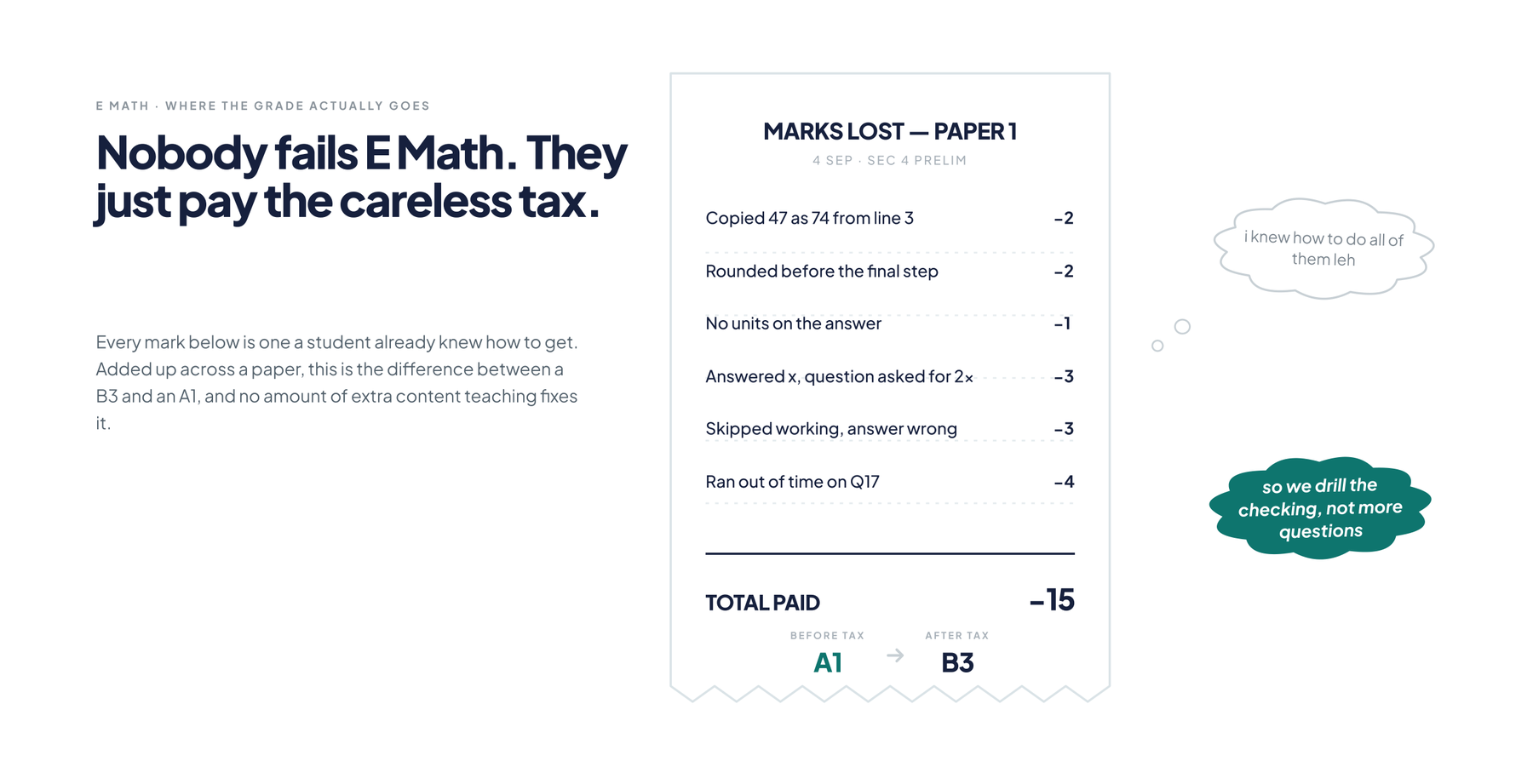
Compound interest and hire purchase sit inside the "Number and its applications" section of the Singapore/Cambridge O-Level E Math syllabus, and they show up almost every year in Paper 1 or as part of a longer Paper 2 question. The good news: these are some of the most predictable marks on the whole paper. Once you know the two formulas and the standard question shapes, you can bank full marks in under five minutes.
The two formulas you must know cold
Compound interest
If a principal amount $P$ earns interest at $r%$ per annum, compounded once a year for $n$ years, the total amount is:
$$A = P\left(1 + \frac{r}{100}\right)^n$$
If interest is compounded more than once a year (monthly, quarterly, half-yearly), split the rate and multiply the periods:
$$A = P\left(1 + \frac{r}{100k}\right)^{nk}$$
where $k$ is the number of compounding periods per year. So monthly means $k = 12$, quarterly means $k = 4$, half-yearly means $k = 2$.
For depreciation (a car losing value, a machine wearing out), the sign flips:
$$A = P\left(1 - \frac{r}{100}\right)^n$$
Interest earned is not the same as the amount. Interest $= A - P$. Students lose marks here every single year because they write down $A$ when the question asked for the interest.
Hire purchase
Hire purchase questions almost always use simple interest on the balance after the deposit. The structure is:
- Deposit $=$ given percentage of the cash price
- Balance $=$ cash price $-$ deposit
- Interest $=$ balance $\times \dfrac{r}{100} \times$ number of years
- Total instalments $=$ balance $+$ interest
- Monthly instalment $=$ total instalments $\div$ number of months
- Total hire purchase price $=$ deposit $+$ total instalments
The classic trap is mixing up steps 3 and 5. Interest is per annum, so use years. Instalments are paid monthly, so use months.
Worked example: compound interest
A man deposits $5000 in a bank account paying 3% per annum compounded monthly. Calculate the interest earned after 4 years, correct to the nearest cent.
$$A = 5000\left(1 + \frac{3}{100 \times 12}\right)^{4 \times 12} = 5000(1.0025)^{48} = 5636.64$$
Interest $= 5636.64 - 5000 = $636.64$.
Notice the answer is in two lines. The mark scheme typically gives one mark for the correct substitution into the formula and one for the final answer, so always write the substituted formula before you press the buttons. Even if your calculator slips, the method mark is safe.
Worked example: hire purchase
The cash price of a washing machine is $2400. Under a hire purchase scheme, a customer pays a deposit of 20% and the remaining balance plus simple interest at 6% per annum over 2 years, in 24 equal monthly instalments. Find (a) the monthly instalment, (b) how much more the customer pays than the cash price.
(a) Deposit $= 0.20 \times 2400 = $480$
Balance $= 2400 - 480 = $1920$
Interest $= 1920 \times \dfrac{6}{100} \times 2 = $230.40$
Total instalments $= 1920 + 230.40 = $2150.40$
Monthly instalment $= \dfrac{2150.40}{24} = $89.60$
(b) Total paid $= 480 + 2150.40 = $2630.40$, so the customer pays $2630.40 - 2400 = $230.40$ more.
Part (b) has a shortcut: the extra paid is exactly the interest, because the deposit and balance already add back to the cash price. Spotting that saves you a minute, but write the full working if you are unsure.
Question types that catch people out
- Find the number of years. You cannot use logarithms in E Math, so use trial and improvement. Test $n = 5$, then $n = 6$, and state clearly which is the first year the amount exceeds the target.
- Find the principal. Rearrange: $P = A \div \left(1 + \frac{r}{100}\right)^n$. Do not subtract the interest percentage.
- Compare two schemes. Work out both totals in full, then write a comparison sentence: "Scheme A costs $X less, so Scheme A is the better buy." The final comparison statement usually carries its own mark.
- Currency and GST layered on top. Do the interest calculation first, then apply GST or the exchange rate at the end unless told otherwise.
Rounding rules that protect your marks
- Keep full calculator accuracy in intermediate steps. Store values in your calculator memory rather than retyping a rounded number.
- Round money answers to 2 decimal places unless the question says otherwise, and write the dollar sign.
- Numbers of years or instalments are whole numbers. If your trial gives 5.7 years, the answer is 6 years.
- Read the units in the question stem twice. "Per annum compounded quarterly" is the phrase that decides your $k$.
How to drill this in a week
Pull ten past-paper questions on interest, hire purchase and money, and do them in one sitting with a timer. Then mark yourself strictly against the answer scheme, circling every place you dropped a mark for rounding or for answering the wrong quantity. These questions are worth roughly 3 to 5 marks each and are far more reliably scored than a hard trigonometry proof.
Want a tutor who sat these exact papers recently to walk you through your working line by line? Message us on WhatsApp to book a free trial class with Dojo.