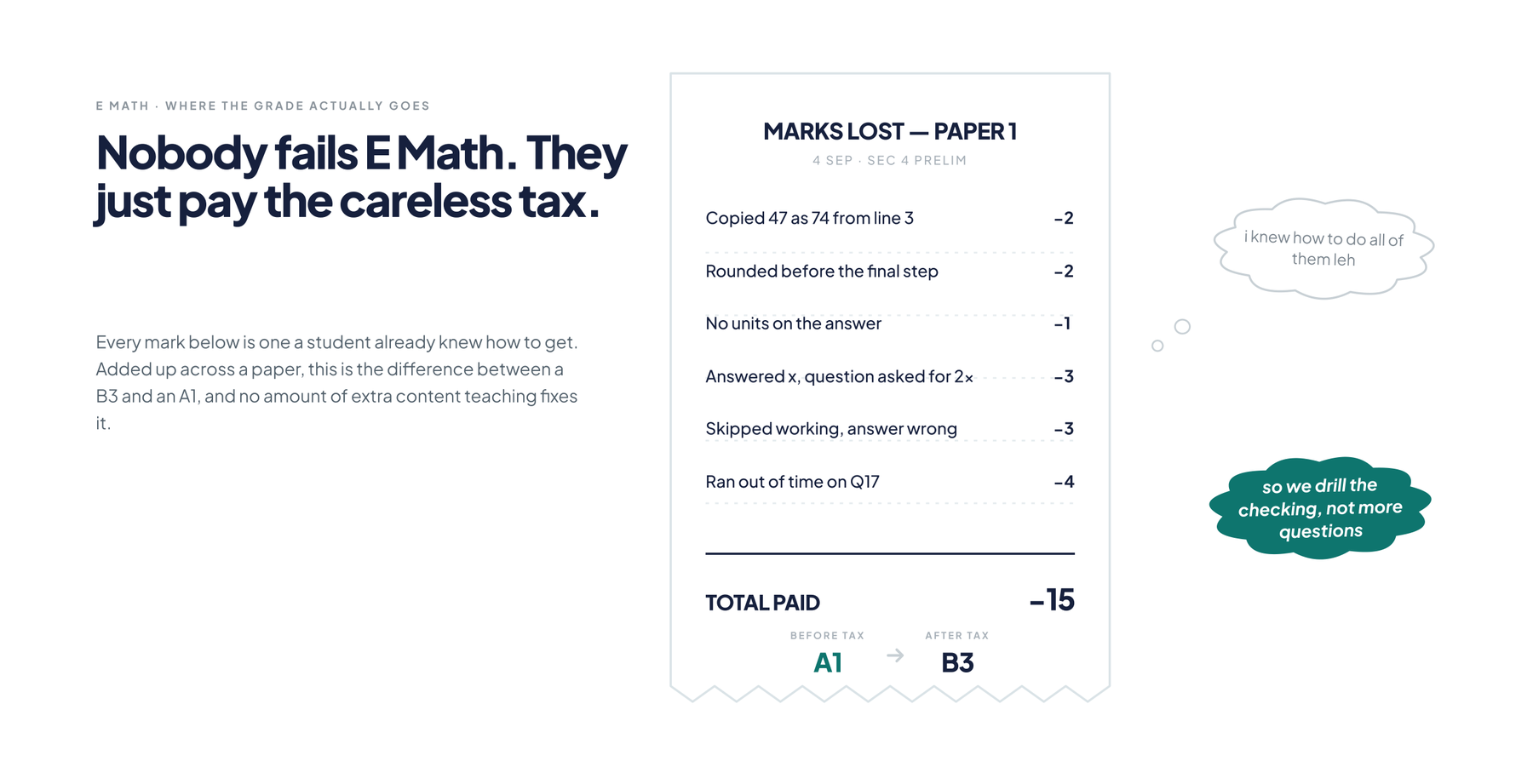
Circle properties are one of the most predictable topics in O-Level E Math Paper 2. The angles are not the hard part. The marks that students lose again and again are the reason marks, the short phrases you must write next to each step to show why an angle is what it is.
Here is exactly how to structure these answers so you collect every mark available.
Why reasons carry marks
In the Singapore/Cambridge E Math syllabus (4052), circle geometry questions are usually phrased as "Find angle ABC, stating your reasons clearly" or "Show that angle PQR = 62°, giving a reason for each step."
When a question says stating reasons, the mark scheme splits the marks:
- One mark for the correct numerical answer
- One or more marks for correctly named properties
So a student who writes only "= 62°" with no working can score 1 out of 3 even though the answer is perfect. A student who writes the property for each step but slips on arithmetic can still score 2 out of 3. Reasons are the cheapest marks in the whole paper.
The eight properties you must be able to name
Memorise these in the exact wording. Markers accept standard phrasing, and standard phrasing is safest.
- Angle at centre = 2 × angle at circumference (same arc)
- Angles in the same segment are equal
- Angle in a semicircle = 90°
- Opposite angles of a cyclic quadrilateral are supplementary (sum to 180°)
- Exterior angle of a cyclic quadrilateral = interior opposite angle
- Tangent ⟂ radius at point of contact
- Tangents from an external point are equal (so the triangle formed is isosceles)
- Tangent–chord angle (alternate segment theorem): the angle between tangent and chord equals the angle in the alternate segment
Also keep the non-circle basics handy, because most questions mix them in:
- Angle sum of triangle = 180°
- Base angles of isosceles triangle are equal
- Angles on a straight line = 180°
- Vertically opposite angles are equal
- Alternate/corresponding angles, parallel lines
The three-column method
Do not write a paragraph. Write one line per step, in this shape:
Angle OAB = 90°      (tangent ⟂ radius)
Angle AOB = 180° − 90° − 34° = 56°   (angle sum of triangle)
Angle ACB = 56° ÷ 2 = 28°   (angle at centre = 2 × angle at circumference)
Three things make this work:
- Each line states which angle, so the marker never has to guess.
- Each line has one reason, not two squashed together.
- The final line clearly gives the required angle.
If you need two properties in one step, split it into two lines. Two lines cost you ten seconds and can win you a mark.
Name the angle properly
Write "angle ABC", not "angle B", when three or more lines meet at B. Examiners will not award a reason mark for an angle they cannot identify. Use the letters printed on the diagram, in order.
A worked example
A, B, C and D lie on a circle. TA is a tangent at A. Angle TAB = 58° and angle BDC = 40°. Find angle ACB and angle BAC.
Angle ACB = 58°   (tangent–chord angle, alternate segment theorem)
Angle BAC = angle BDC = 40°   (angles in the same segment, arc BC)
Notice the second line names the arc. That is not compulsory, but it proves to the marker you know which pair of angles you are comparing, and it stops you from pairing the wrong two angles in a busy diagram.
Common mistakes we see in marking
- Writing "circle property" or "cyclic quad" as the reason. Too vague. Say which property.
- Assuming a line through the circle is a diameter because it looks straight through the middle. Only use "angle in a semicircle" if the diagram or question states the line passes through the centre O.
- Using "angles in the same segment" for angles on opposite sides of the chord. They must be in the same segment, both above or both below the chord.
- Forgetting the isosceles triangle. Any two radii form an isosceles triangle. This is the most commonly missed step in centre-angle questions.
- Skipping to the answer. If you can see the answer instantly, still write two lines of reasoning. The marks are for the reasoning.
Your five-minute practice routine
Take any past-year circle question and do this:
- Mark the centre, tangents and right angles onto the diagram first.
- Write down every angle you can find immediately, with reasons, even if they are not asked for.
- Then look for the target angle. Usually it is now one step away.
Working outwards from what you know beats staring at what you want.
Want a tutor who has recently sat this exact paper to check your reason phrasing line by line? Book a 1-to-1 trial with us on WhatsApp: https://wa.link/x755zl