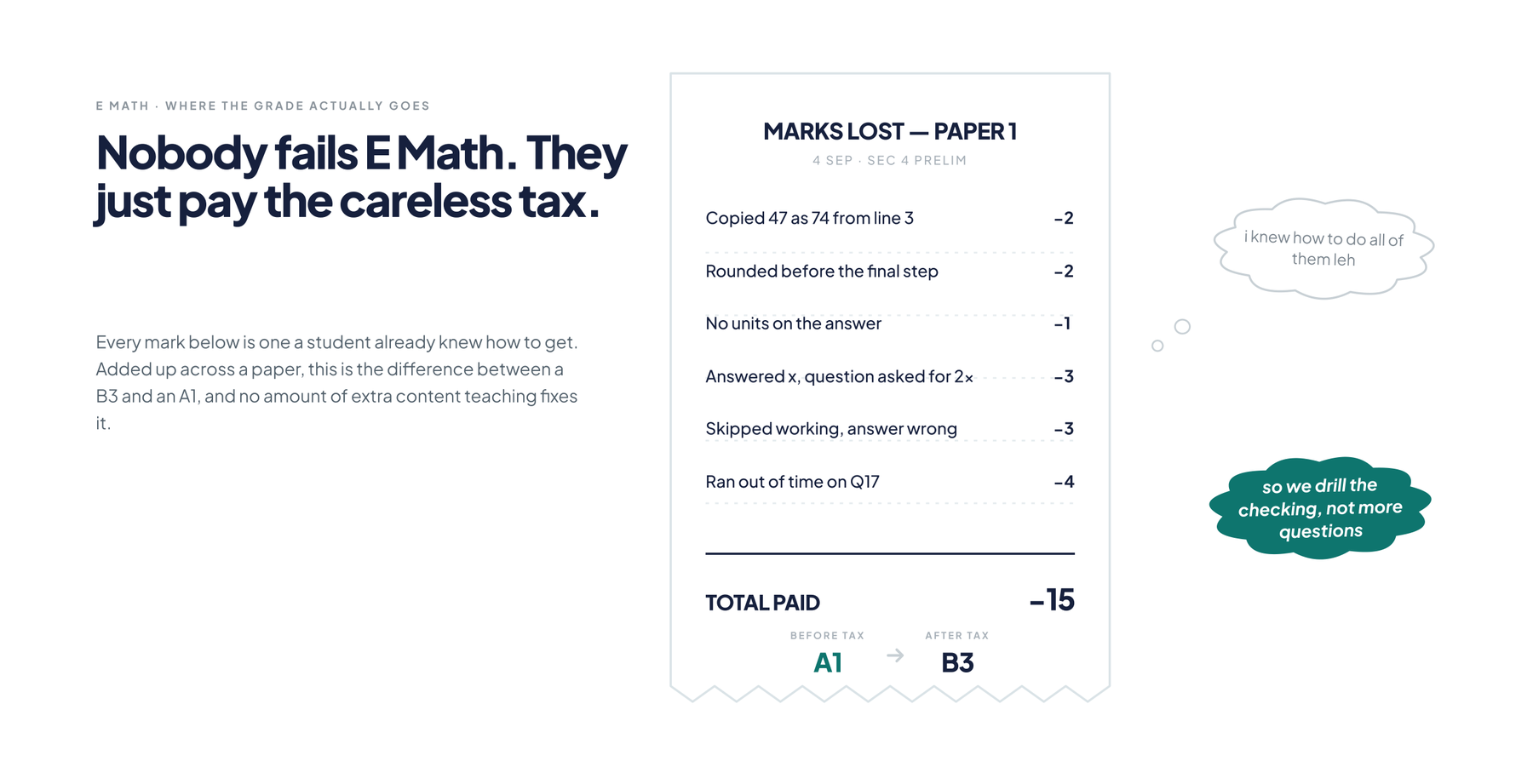
If you have ever walked out of an E Math paper feeling good, then opened the marked script to find you dropped six marks on silly errors, this post is for you. In Elementary Mathematics, the content is rarely the problem. Careless mistakes are. The good news is that carelessness is a habit, and habits can be trained. Here is the system our students use.
Careless mistakes are not random
It feels like slips happen by bad luck, but they cluster in predictable places:
- Copying errors: writing 47 as 74, or dropping a minus sign when moving a term across the equals sign.
- Calculator misuse: forgetting brackets, so the calculator computes the wrong order of operations.
- Unit and rounding errors: giving an answer in centimetres when the question asked for metres, or rounding too early so the final answer drifts.
- Half-finished questions: finding x but forgetting the question also asked for y.
Once you know your personal pattern, you can hunt for it deliberately.
The three-pass method
Do not check your paper by reading it top to bottom, that just repeats the same thinking that made the error. Use three targeted passes instead:
- The method pass. Skim each question and ask "did I answer what was actually asked?" This catches half-finished questions and misread stems.
- The number pass. Re-key every calculation into your calculator, especially anything with brackets, powers, or fractions. Do not trust the first entry.
- The presentation pass. Check units, significant figures, and that your final answer is clearly stated and matches the context. A negative length or a probability greater than one is a red flag.
Three focused passes beat one anxious read-through every time.
Set up your working to be checkable
You cannot check messy working. Build good habits into how you write:
- One line per step. Cramming three operations onto one line hides errors.
- Show the substitution before you compute. Writing the numbers in first makes a wrong value obvious.
- Box your final answer with its units. It forces you to confirm the question is fully answered.
Neat working is not about looking good for the examiner. It is a tool that lets you find your own mistakes.
Practise checking, not just solving
Most students practise by doing questions and moving on. Add a second step: after finishing a past paper, before you look at the answers, run your three-pass check and try to catch your own errors. Then mark it. The gap between your check and the real marks tells you exactly what to watch for next time.
Where a tutor helps most
The fastest way to fix careless mistakes is to have someone mark your paper the way Cambridge does and point out the pattern you cannot see yourself. In a Dojo E Math class, that is exactly what happens. You do timed papers, get examiner-style marking, and build a checking routine that becomes automatic by exam day.
Want to see how it works? Book a 1-to-1 trial and a tutor will go through your latest paper with you.