Paper 1 of O-Level Pure Chemistry (6092) is 40 multiple-choice questions in one hour, and it carries 30% of your final grade. That works out to about 90 seconds per question. Many students treat it as the "easy paper" and lose 6 to 8 marks to careless reading, which is often the exact gap between an A2 and an A1.
Here is how our tutors, who sat these papers recently, approach Paper 1.
Understand what MCQ actually tests
MCQ is not a recall quiz. The Cambridge and MOE syllabus tests four skill types, and almost every question falls into one of them:
- Direct recall: gas tests, colours of precipitates, reactivity series, definitions.
- Application: given an unfamiliar substance or reaction, apply a rule you know.
- Data interpretation: rate graphs, solubility curves, titration data, tables of properties.
- Calculation: moles, percentage yield, empirical formula, gas volumes, concentration.
When you open a question, name the type in your head. If it is recall, you either know it or you eliminate. If it is application, you must stop and reason. Mixing these up is why students rush the wrong questions.
The two-pass method
Do not answer in a straight line from 1 to 40.
- Pass 1 (about 35 minutes): answer everything you can do confidently. Mark any question that needs real working with a dot in the margin.
- Pass 2 (about 15 minutes): return to the dotted questions with a clear head.
- Final 5 minutes: check that every OAS bubble is shaded, and that no question is blank.
There is no penalty for a wrong answer, so a blank is a guaranteed zero. Even a 1 in 4 guess beats that.
Eliminate on paper, not in your head
The single biggest improvement we see is students physically crossing out options with a one-word reason next to them. For example:
Which substance conducts electricity when molten but not when solid?
A. Graphite, B. Sodium chloride, C. Sulfur, D. Poly(ethene)
Write "conducts solid" beside A, "non-metal, no ions" beside C, "polymer" beside D. Answer B, and you have a written trail if you come back later. Guessing after eliminating two options doubles your odds.
Traps that appear every year
- Negative wording: "which is NOT", "which cannot", "which is least". Underline these words the moment you see them.
- Absolutes: "always", "only", "all". One counter-example kills the option.
- Statement combinations (I, II and III): judge each statement true or false independently before you look at the answer combinations. Students who scan the combinations first talk themselves into errors.
- Units and prefixes: cm³ versus dm³ is the most common calculation slip. 1000 cm³ = 1 dm³. Convert before you substitute.
- Half equations versus overall equations: in electrolysis questions, check whether the option describes what happens at the electrode or in the whole cell.
- Diagrams drawn to mislead: in apparatus questions, check the position of the delivery tube, whether the gas is denser than air, and whether the setup would actually collect the product.
High-yield topics for MCQ
MCQ favours topics that can be tested in one clean question. Drill these hardest:
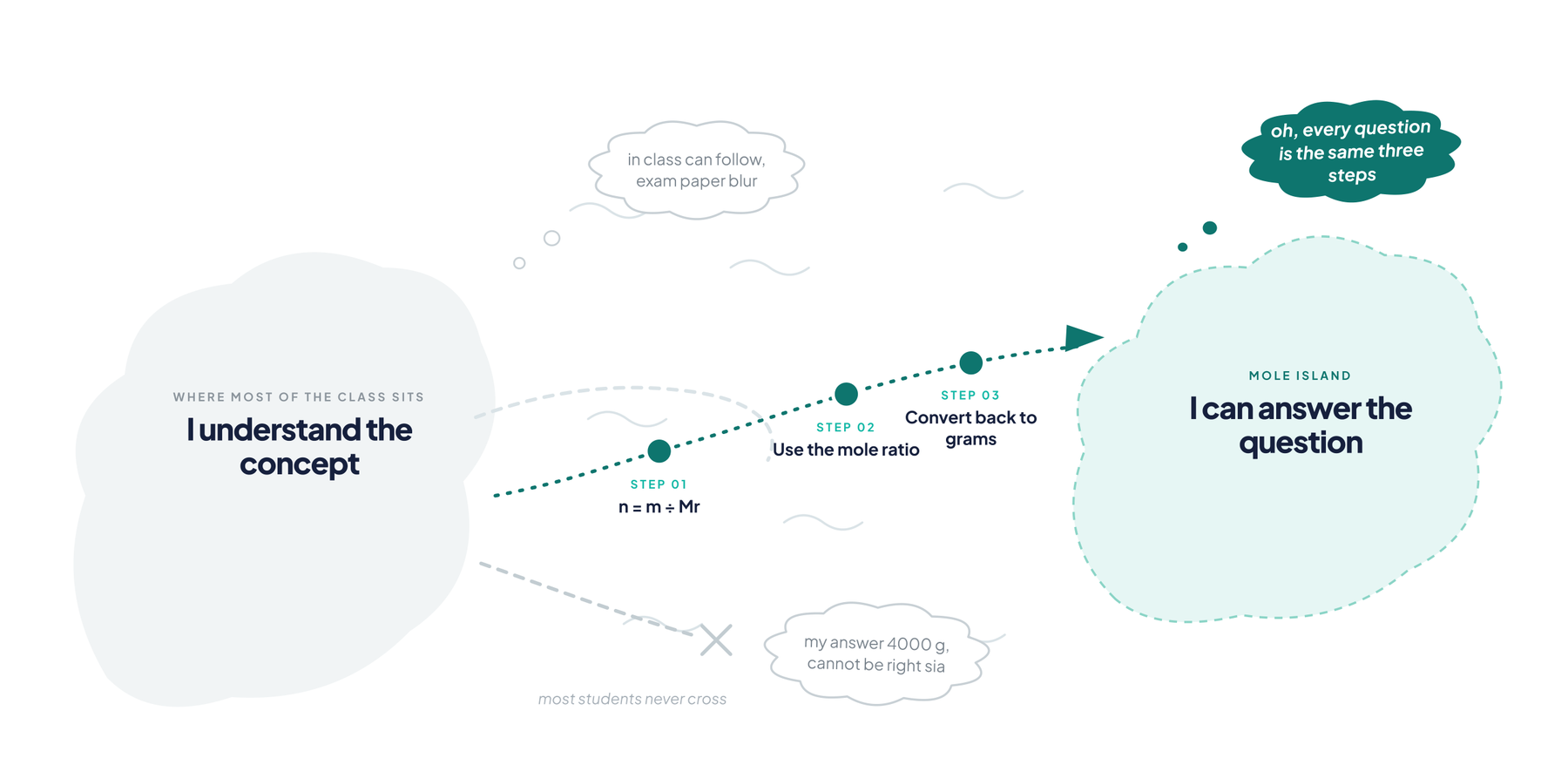
- Mole calculations, especially limiting reagent and molar gas volume at room conditions (24 dm³/mol).
- Qualitative analysis: cation tests with aqueous NaOH versus aqueous ammonia, and the precipitates that redissolve.
- Electrolysis: selective discharge, dilute versus concentrated solutions, and inert versus reactive electrodes.
- Redox: oxidation state changes, identifying the oxidising agent, and why one species is reduced.
- Periodic trends across Period 3 and down Group VII.
- Rate of reaction graphs: gradient means rate, plateau height means amount of product.
- Organic chemistry: homologous series, isomers, and reaction conditions for cracking, addition and fermentation.
- Structure and bonding linked to properties such as melting point, conductivity and solubility.
Build an error log, not a pile of papers
Doing 20 MCQ papers without reviewing them will not raise your grade. After every set, record in a notebook:
- The question and the option you chose.
- The correct option.
- One line on why you were wrong: careless reading, missing concept, or unit error.
After three weeks you will notice your mistakes cluster into two or three repeating causes. Fixing those is worth more than another 200 questions.
Timed practice, weekly
Once a week, sit 40 questions in exactly 60 minutes with no phone and no notes. Speed under pressure is a separate skill from accuracy at home, and Paper 1 rewards both.
Want a tutor who has recently scored in this exact paper to go through your error log with you? Message us on WhatsApp to book a 1-to-1 trial: https://wa.link/x755zl