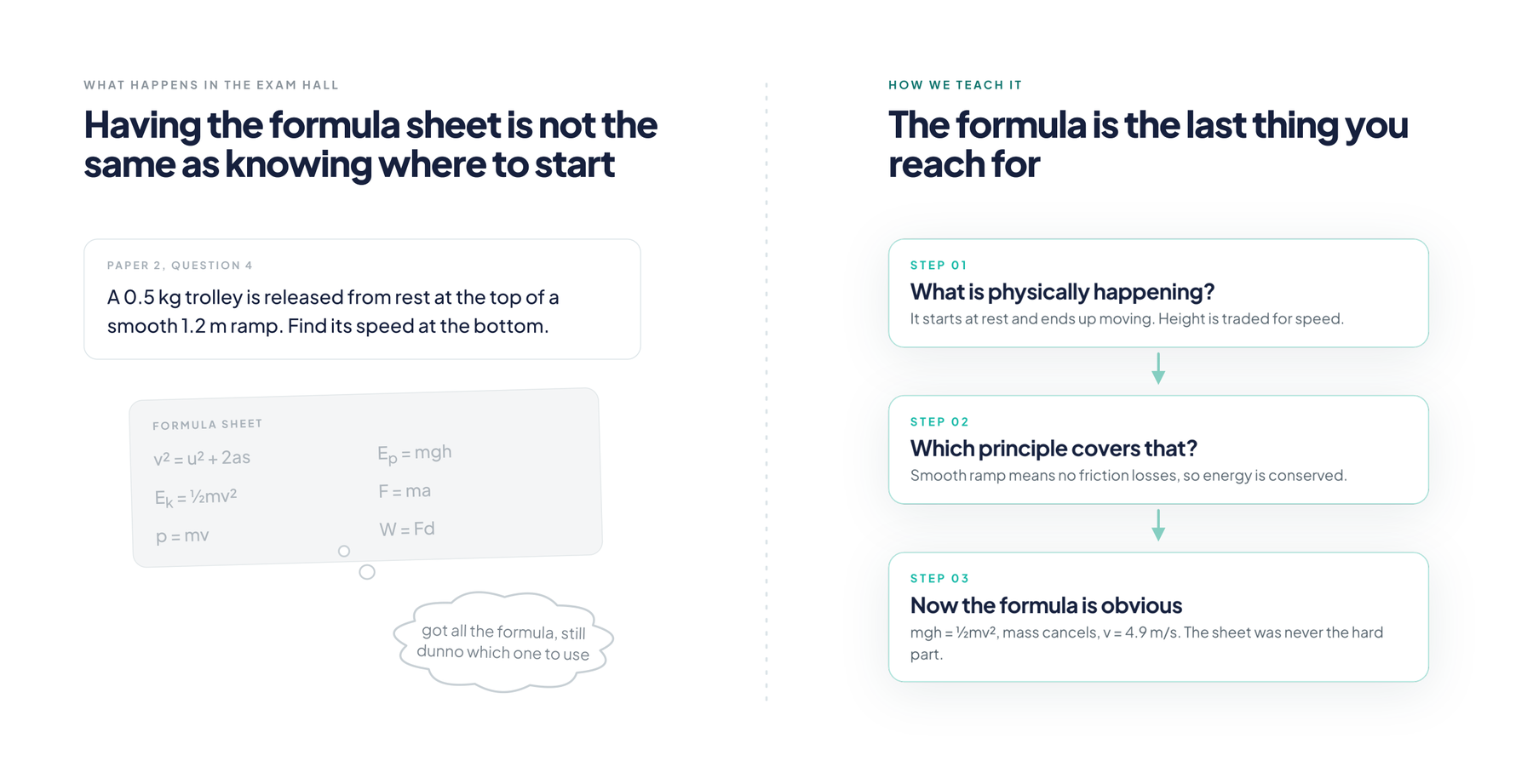
Work, Energy and Power is one of the friendliest topics in the Combined Science (Physics) syllabus, because almost every question comes down to three or four equations you already know. The marks are lost not on the physics, but on the presentation: missing units, wrong height, forgetting that efficiency is never 100%, or quietly skipping the substitution line that the examiner is paid to tick.
Here is how we teach students at Dojo to lock down every mark in this topic.
The four equations you must have at your fingertips
For Combined Science, you need these and very little else:
- Work done: W = F × d, where d is the distance moved in the direction of the force
- Gravitational potential energy: E_p = mgh, with g = 10 N/kg unless the paper says otherwise
- Kinetic energy: E_k = ½mv²
- Power: P = W / t or P = E / t
- Efficiency: (useful energy output ÷ total energy input) × 100%
Everything else is bookkeeping. The examiner wants to see that you can pick the right one, substitute cleanly, and carry the correct unit.
The four-line method that earns full marks
Combined Science calculation questions are usually worth 2 to 4 marks, and the marks are split roughly as: formula, substitution, answer, unit. So write four lines every single time, even when you can do it in your head.
- Write the formula in symbols. Not "1200 ÷ 4" but "P = E / t".
- Substitute the numbers with units where helpful.
- Give the answer to 3 significant figures unless the question says otherwise.
- Write the unit. J, N, W, kg, m. A naked number loses a mark.
If you get stuck halfway, the formula line still scores. Students who jump straight to a calculator answer get zero when the arithmetic slips.
Worked example 1: lifting a load
A crane lifts a 250 kg crate through a vertical height of 12 m in 20 s. Calculate the useful power output of the crane. (g = 10 N/kg)
E_p = mgh
E_p = 250 × 10 × 12 = 30 000 J
P = E / t
P = 30 000 / 20 = 1500 W
Notice two things. The height is the vertical height, not the length of any cable or slope. And the answer is in watts, not joules, because the question asked for power.
Worked example 2: energy conversion on a slope
A 0.50 kg ball is released from rest at a height of 1.8 m and rolls down a smooth slope. Calculate its speed at the bottom.
The key sentence in your answer is the conservation statement. Examiners like to see it written out:
Assuming no friction, gravitational potential energy lost = kinetic energy gained.
mgh = ½mv²
0.50 × 10 × 1.8 = ½ × 0.50 × v²
9.0 = 0.25 v²
v² = 36
v = 6.0 m/s
Because mass cancels, you could also write gh = ½v². If the question then asks why the real speed is lower, the answer is: some energy is converted to thermal energy (and sound) due to friction, so less energy is available as kinetic energy. Say "converted to", never "lost" or "used up". Energy is conserved, and the mark scheme cares.
Worked example 3: efficiency
A motor uses 4000 J of electrical energy to raise a 15 kg mass through 20 m. Calculate the efficiency of the motor.
Useful output = mgh = 15 × 10 × 20 = 3000 J
Efficiency = (3000 / 4000) × 100% = 75%
Efficiency has no unit. Writing "75% J" is an instant lost mark, and any answer above 100% means you have swapped the numerator and denominator.
Common mistakes we see in Combined Science scripts
- Using the slope distance in mgh. Use vertical height for E_p and the distance along the force for W = F × d.
- Forgetting to square v in ½mv², or squaring the whole ½mv.
- Mixing grams and kilograms. Convert 500 g to 0.5 kg before substituting. Same for cm to m and minutes to seconds.
- Weight versus mass. A 60 kg student has a weight of 600 N. Work done climbing stairs uses the weight in newtons.
- Rounding too early. Keep full values in your calculator and round only the final answer.
- Answering "why is energy lost" with "because of friction" and stopping there. Name the energy store: thermal energy in the surroundings.
A two-minute drill before your paper
Take any past-year question on this topic, cover the solution, and write only the formula lines. No arithmetic. If you can pick the right equation in under ten seconds for ten questions in a row, the topic is secure. Speed here buys you time for the structured questions later in the paper.
If calculation questions are still costing you marks, come and work through a few with us. Start a free trial class on WhatsApp at https://wa.link/dsgbkf and see how it feels to solve these with a tutor who sat the same paper recently.