Situational writing is the part of O-Level English Paper 1 that students most often underrate, and it is the easiest place to pick up reliable marks. Unlike the essay, it is not about creativity. It is about hitting a clear set of requirements: the right purpose, the right audience, the right tone, and every point from the text used well. Get systematic about it and this becomes a section you can almost bank.
Read the task before you read the text
The temptation is to dive into the reading passage. Do not. Read the task first and extract three things:
- Purpose: are you persuading, informing, advising, or reporting?
- Audience: a friend, a principal, a committee, the public? This sets your tone.
- Format: an email, a letter, a report, a speech? Each has its own conventions.
Only once you know these should you go back and mine the text for content. Reading in that order stops you from writing a technically fine piece that answers the wrong brief.
Match tone to audience, deliberately
Tone is where a lot of marks quietly disappear. Writing to a principal is not the same as writing to a friend. A quick guide:
- Formal audience (principal, committee, official): full sentences, no contractions, measured and respectful.
- Semi-formal (a teacher you know, an organisation): polite and clear, a little warmth is fine.
- Informal (a friend, a peer): natural and friendly, but still organised and purposeful.
Decide the register before you write the first line, and hold it consistently to the end.
Use every point, and add value
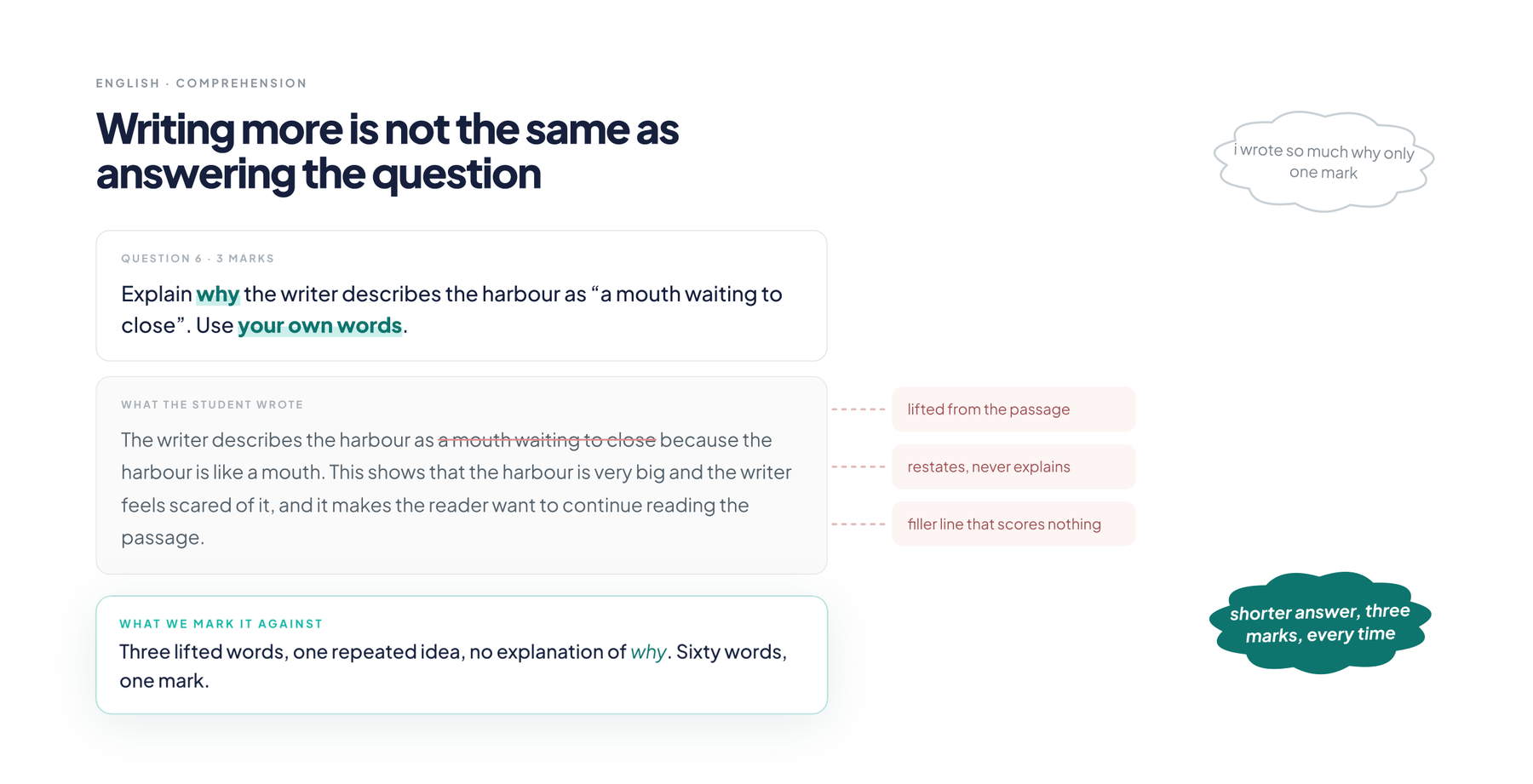
The marks reward you for using the information in the passage, but the strongest answers do not just copy points across. They select the relevant ones, group them logically, and add a sentence of your own reasoning that shows you understood why each point matters. Lifting phrases word for word signals weaker understanding. Rephrasing in your own words signals control of the language.
Do not throw away the format marks
Format marks are the easiest in the whole paper, and students lose them by rushing. Depending on the task:
- A letter or email needs an appropriate greeting and sign-off.
- A report needs a clear title and often headings.
- A speech needs a direct address to the audience and a strong opening and closing.
Learn the conventions for each format once, and you will never leave those marks on the table again.
Plan for two minutes, then write
A two-minute plan saves you from the biggest situational-writing mistake, which is running out of points halfway or repeating yourself. Jot the purpose, audience, tone, and the order of your points before you start. It reads far more organised, and organisation is exactly what the mark scheme rewards.
How Dojo builds the habit
In a Dojo English class, you practise situational writing to the real marking criteria, with a tutor who breaks down exactly why one answer scores in the top band and another does not. You learn to hit purpose, audience, and tone on autopilot, so the marks become predictable instead of hopeful.
Want to see how it works? Book a 1-to-1 trial and a tutor will go through your latest paper with you.