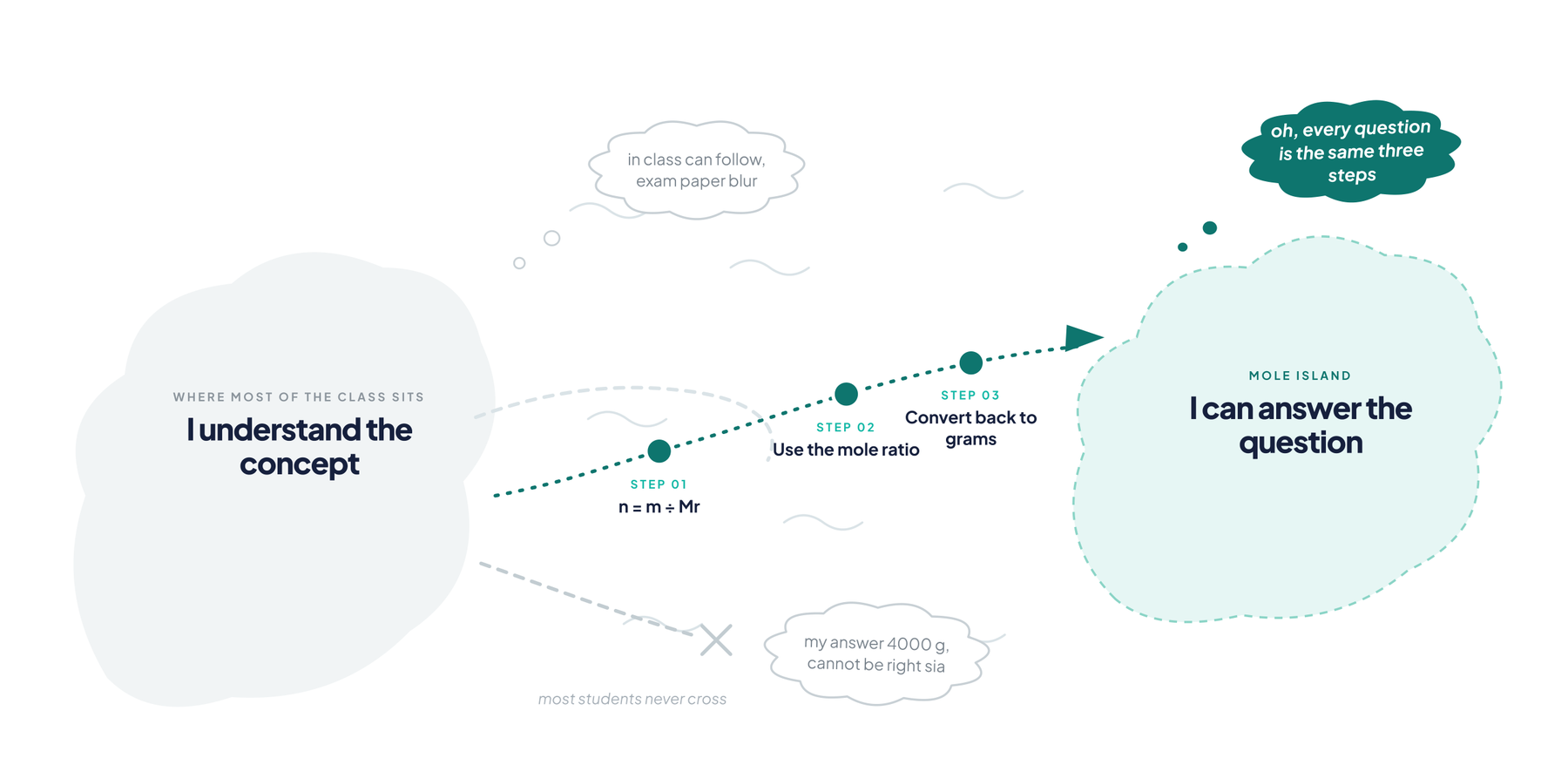
Mole calculations are the single highest-yield topic in O-Level Chemistry Paper 2. They appear in almost every year's paper, they carry 3 to 6 marks at a time, and unlike qualitative analysis or organic chemistry, the marks are completely predictable. If you can run the same method reliably, you get the marks reliably.
The problem is that most students learn moles as a pile of unrelated formulas. Then a limiting reagent question appears, two reactants are given, and the whole thing collapses. Here is how our tutors teach it.
The three formulas you actually need
Everything in the O-Level (Cambridge 6092 and 6087) stoichiometry syllabus reduces to three relationships:
- Mass: moles = mass (g) ÷ molar mass (g/mol)
- Solutions: moles = concentration (mol/dm³) × volume (dm³)
- Gases: moles = volume (dm³) ÷ 24 at room temperature and pressure
That is it. Every other quantity, percentage yield, percentage purity, empirical formula, titration, is built from these three plus the balanced equation.
A note on units, because this is where marks quietly disappear: volume in cm³ must be divided by 1000 before you use formula 2. Writing 25.0 cm³ instead of 0.0250 dm³ is the most common single error we see in marked scripts.
The 4-step method that works every time
Use this structure for every calculation question, even the easy ones. Consistency under exam pressure is what separates a B3 from an A1.
Step 1: Write the balanced equation. If the question gives it, copy it out. If not, write and balance it yourself. Without the mole ratio, nothing else works.
Step 2: Convert everything you are given into moles. Do this for every substance with a number attached, even if you are not sure you need it.
Step 3: Use the mole ratio from the equation to find moles of what you want.
Step 4: Convert moles back into the quantity asked for, mass, volume, or concentration.
Lay this out vertically down the page with each line labelled. Examiners award method marks, and they can only award them if they can see your working.
Worked example: a classic limiting reagent question
4.00 g of magnesium is added to 100 cm³ of 1.00 mol/dm³ hydrochloric acid. (a) Determine which reactant is in excess. (b) Calculate the volume of hydrogen produced at r.t.p. (c) Calculate the mass of the excess reactant remaining.
Step 1: Mg + 2HCl → MgCl₂ + H₂
Step 2:
- Moles of Mg = 4.00 ÷ 24.0 = 0.167 mol
- Moles of HCl = (100 ÷ 1000) × 1.00 = 0.100 mol
Step 3, the comparison. Do not compare the raw mole numbers. Compare against the ratio. From the equation, 0.167 mol of Mg would need 0.334 mol of HCl. Only 0.100 mol of HCl is available, so HCl is the limiting reagent and Mg is in excess.
For (b), work from the limiting reagent only. Moles of H₂ = 0.100 ÷ 2 = 0.0500 mol. Volume = 0.0500 × 24 = 1.20 dm³ at r.t.p.
For (c), moles of Mg that actually reacted = 0.100 ÷ 2 = 0.0500 mol. Moles of Mg left over = 0.167 − 0.0500 = 0.117 mol. Mass = 0.117 × 24.0 = 2.81 g.
Mark-scheme phrasing that earns the mark
When a question says "explain which reactant is in excess", a bare number is not enough. Write a sentence like this:
"0.167 mol of Mg requires 0.334 mol of HCl, but only 0.100 mol of HCl is present, so HCl is limiting and Mg is in excess."
That one sentence contains the comparison, the ratio and the conclusion, which is exactly what the mark scheme is looking for.
Common mistakes to eliminate this week
- Forgetting to convert cm³ to dm³ before multiplying by concentration.
- Using the reactant in excess to calculate the product. Always calculate products from the limiting reagent.
- Ignoring the mole ratio and assuming 1:1. Check the coefficients every single time.
- Rounding too early. Carry at least 4 significant figures through your working and round only at the end, then give your answer to 3 significant figures.
- Using molar volume 24 dm³ for a substance that is not a gas, or forgetting that r.t.p. values differ from s.t.p.
- Writing the answer without units. Free marks lost.
How to practise efficiently
Do not do ten random questions. Do five questions of the same type back to back until the 4-step layout becomes automatic, then switch type. Work through past-year Paper 2 structured questions on titration, percentage yield and gas volumes, and mark yourself against the official mark scheme so you learn what phrasing earns credit.
A good habit for the last month before the exam: every time you get a stoichiometry question wrong, write down which of the four steps failed. Most students find the same step fails repeatedly, and fixing one habit fixes twenty marks.
If mole calculations still feel shaky, come and work through a few with us. Message us on WhatsApp at https://wa.link/x755zl to book a 1-to-1 Chemistry trial with a tutor who sat these papers recently.