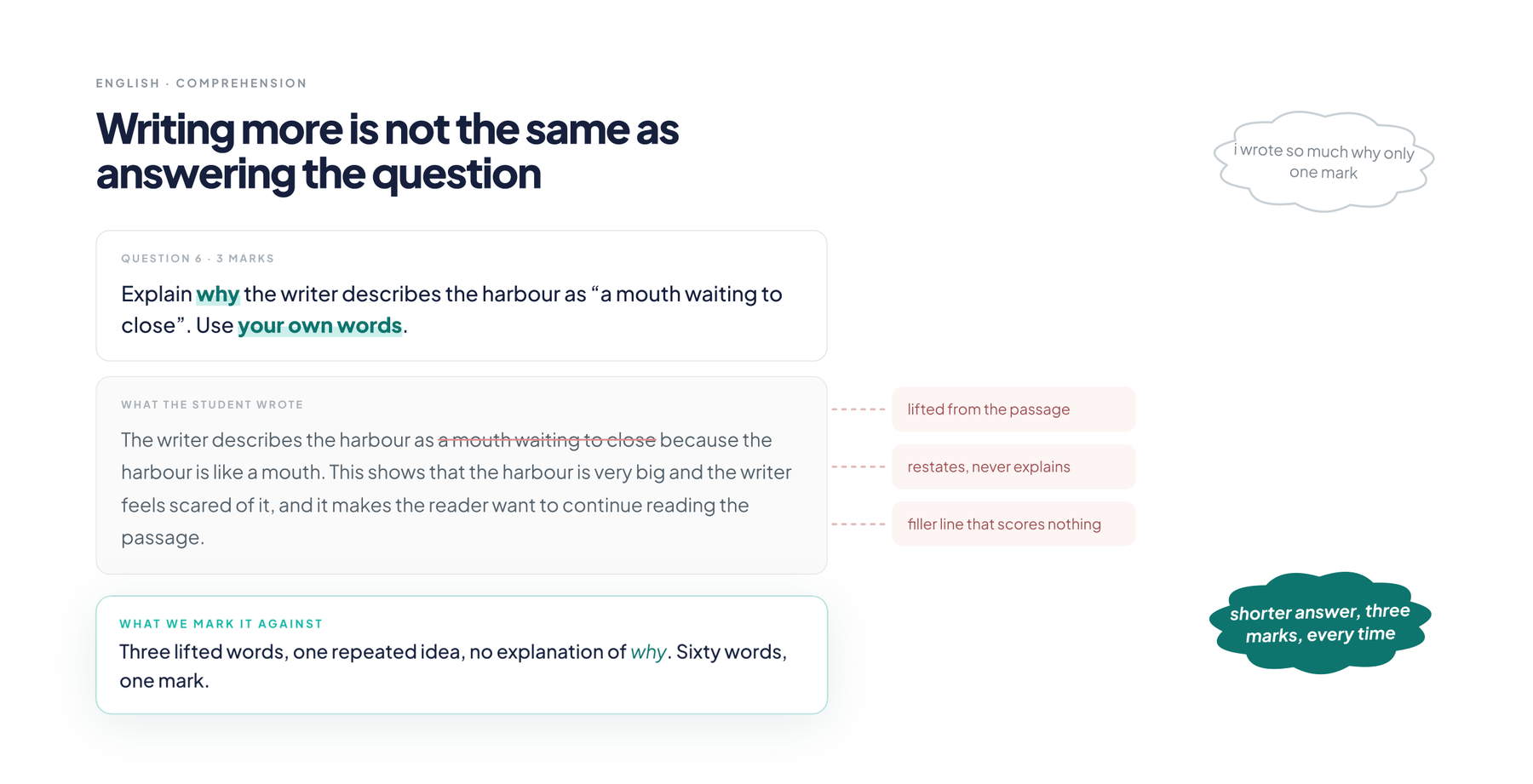
Why this question type costs so many marks
In Paper 2, the phrase "Using your own words as far as possible" is doing something very specific. The examiner has already decided which ideas in the passage carry the meaning, and your job is to show you understood them by expressing them differently. If you copy the writer's phrasing, you have proved nothing, and the mark cannot be awarded even if your answer sits right next to the correct line in the text.
This is one of the most trainable skills in the whole O-Level English syllabus. It is not about having a bigger vocabulary than everyone else. It is about a repeatable process.
What the marker is actually looking for
Markers work point by point. A 2-mark "own words" question usually contains two key ideas, and each idea is built around one or two content words: the nouns, verbs, adjectives and adverbs that carry the meaning.
For each idea, the marker asks:
- Has the student identified the correct part of the passage?
- Have the content words been substituted with a reasonable equivalent?
- Does the meaning still hold in context?
If the answer to (2) is no, that idea scores zero. This is why students who "understood the passage perfectly" still lose four or five marks across a paper.
The five-step method
Step 1: Locate, do not hunt
The question almost always quotes or references a line. Underline that exact phrase in the passage, then read the sentence before and after it. Most answers live within a two-sentence window. Do not scatter your search across the whole text.
Step 2: Bracket the lifted zone
Draw brackets around the words you are going to have to change. Being visually clear about what must be rewritten stops you from accidentally copying half a clause.
Step 3: Circle content words only
You do not need to paraphrase everything. Function words such as "the", "of", "because", "and" can stay. Circle the words doing the heavy lifting.
Step 4: Substitute in context
Replace each circled word with something that fits both the meaning and the grammar. Say the sentence in your head. If it sounds unnatural, your synonym is wrong.
Step 5: Answer the question stem
Check the command word. If the question asks why, your answer must read as a reason. If it asks how, it must read as a method. Paraphrasing correctly but answering the wrong question still scores zero.
A worked example
Passage line:
"The relentless pace of urban development has gradually eroded the few remaining green spaces that once offered respite to weary city dwellers."
Question: Using your own words as far as possible, explain why the writer believes the city has become harder to live in. [2]
Content words: relentless pace, urban development, eroded, green spaces, respite, weary city dwellers.
Weak answer (lifted):
Because urban development has eroded the green spaces that offered respite.
Strong answer:
Because the non-stop expansion of buildings and infrastructure has slowly worn away the small number of parks left, which used to give tired residents a chance to rest and recover.
Notice that "city" stays, because there is no clean synonym, and that is acceptable. "As far as possible" means exactly that.
What you are allowed to keep
You may safely retain:
- Proper nouns, names, places and dates
- Numbers and statistics
- Technical or scientific terms with no everyday equivalent, such as photosynthesis or algorithm
- Very simple, unavoidable words such as water, child, year
Do not waste time inventing awkward substitutes for these. Markers do not reward strained paraphrasing.
Five mistakes we see every week
- Thesaurus dumping. Swapping "eroded" for "corroded" changes the meaning. Choose the sense that fits the sentence, not the first entry you remember.
- Copying the connective structure. Changing only the nouns while keeping the writer's sentence skeleton still reads as a lift.
- Over-explaining. A 2-mark question does not need six lines. Extra material can contradict your own correct point.
- Under-covering. Two marks means two distinct ideas. Count them before you write.
- Ignoring register. Informal words such as "stuff", "a lot of" or "kids" pull an answer out of the passage's tone and can obscure meaning.
A ten-minute daily drill
Take any paragraph from a broadsheet article or a past-year passage. Choose three sentences. Rewrite each one twice: once changing only the verbs, once changing only the nouns and adjectives. Then combine your best version. Two weeks of this builds a working bank of substitutions you can reach for under exam pressure, which is exactly what the summary question in Section C rewards as well.
Paraphrasing is a muscle, not a talent. Train it deliberately and "in your own words" becomes the easiest set of marks on the paper.
Want feedback on your own comprehension answers from tutors who sat these papers recently? Start a free trial class with us on WhatsApp.