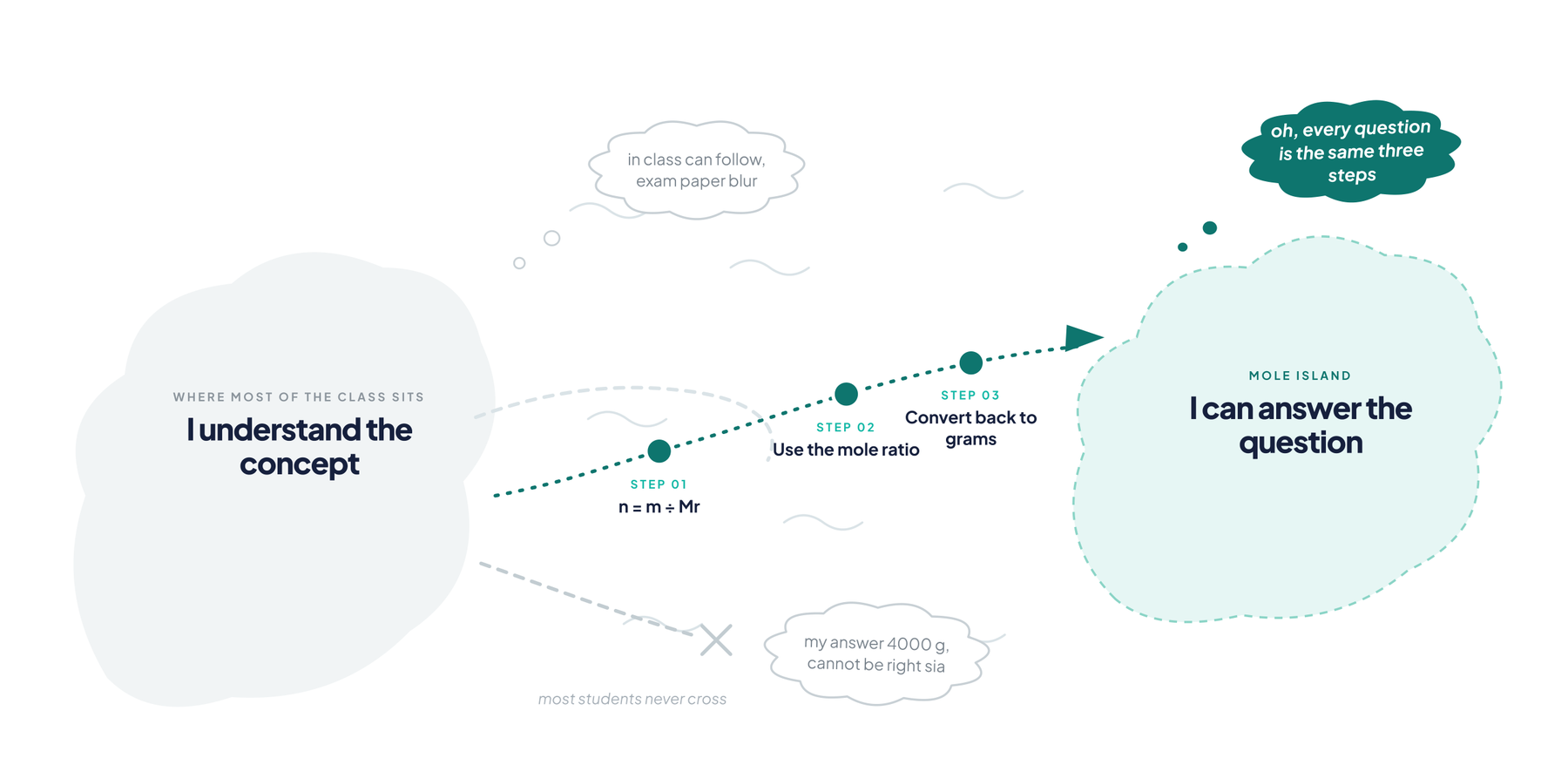
Titration calculations are some of the most predictable marks in the whole O-Level Chemistry paper. The numbers change, the chemicals change, but the structure of the question almost never does. Once you internalise one clean method, you can walk into Paper 2 knowing that four to six marks are already yours.
Here is the exact approach our tutors used when we sat these papers, broken down into steps you can repeat under time pressure.
Why students lose marks here
In our experience marking practice scripts, students rarely fail titration questions because they do not understand the chemistry. They lose marks because they:
- Forget to divide the volume by 1000
- Ignore the mole ratio from the balanced equation
- Mix up mol/dm³ and g/dm³
- Do not scale up from the aliquot (usually 25.0 cm³) to the full volumetric flask (usually 250 cm³)
All four are process errors, not knowledge gaps. That means they are completely fixable.
The four-step framework
Use this every single time, even when the question looks easy.
- Write the balanced equation. If the question gives it, copy it out anyway. You need the ratio in front of your eyes.
- Find moles of the substance you know everything about. That is the one with both a volume and a concentration. Use n = c × V, with V in dm³ (cm³ ÷ 1000).
- Use the mole ratio to convert to moles of the unknown substance.
- Convert to what the question asks for: concentration in mol/dm³, concentration in g/dm³, mass in g, or percentage purity.
Write each step on its own line with units. Method marks are awarded for working, so a wrong final answer with correct working still scores.
Worked example 1: finding a concentration
25.0 cm³ of 0.100 mol/dm³ sodium hydroxide required 20.0 cm³ of dilute sulfuric acid for complete neutralisation. Calculate the concentration of the sulfuric acid in mol/dm³ and in g/dm³.
Step 1: Equation
2NaOH + H₂SO₄ → Na₂SO₄ + 2H₂O
Step 2: Moles of NaOH
n(NaOH) = 0.100 × (25.0 ÷ 1000) = 2.50 × 10⁻³ mol
Step 3: Mole ratio
2 mol NaOH reacts with 1 mol H₂SO₄, so
n(H₂SO₄) = 2.50 × 10⁻³ ÷ 2 = 1.25 × 10⁻³ mol
Step 4: Convert
c(H₂SO₄) = 1.25 × 10⁻³ ÷ (20.0 ÷ 1000) = 0.0625 mol/dm³
Mr of H₂SO₄ = 2 + 32 + 64 = 98
c in g/dm³ = 0.0625 × 98 = 6.13 g/dm³
Notice that the ratio step is the only place chemistry knowledge is tested. Everything else is arithmetic discipline.
Worked example 2: percentage purity with scaling
1.20 g of an impure sample of sodium hydroxide was dissolved in water and made up to 250 cm³ of solution. 25.0 cm³ of this solution required 24.0 cm³ of 0.100 mol/dm³ hydrochloric acid for neutralisation. Calculate the percentage purity of the sample.
NaOH + HCl → NaCl + H₂O
n(HCl) = 0.100 × 0.0240 = 2.40 × 10⁻³ mol
Ratio is 1:1, so n(NaOH) in 25.0 cm³ = 2.40 × 10⁻³ mol
This is the step most students miss. The 25.0 cm³ is one tenth of the 250 cm³ flask, so multiply by 10:
n(NaOH) in 250 cm³ = 2.40 × 10⁻² mol
Mass of pure NaOH = 0.0240 × 40 = 0.960 g
Percentage purity = (0.960 ÷ 1.20) × 100 = 80.0%
Whenever a question mentions a volumetric flask, circle the two volumes immediately and write down the scaling factor before you start calculating.
Getting the titre right first
Some questions ask you to process raw burette readings before any mole work. Remember:
- Burette readings are recorded to 2 decimal places, ending in .00 or .05
- Titre = final reading minus initial reading
- Only average concordant results, meaning titres within 0.10 cm³ of each other. Discard the rough titration.
- If asked to justify your choice, write: "I used only titres 2 and 3 as they are concordant, within 0.10 cm³."
For indicator questions, methyl orange and phenolphthalein score. Universal indicator does not, because it shows a gradual range of colours rather than a sharp end point.
Presentation habits that protect marks
- Show the substituted numbers, not just the formula
- Carry three significant figures through, and only round at the end
- Always state units in the final answer
- Underline or box the answer so the marker cannot miss it
Quick self-check list
Before moving on, ask yourself: did I balance the equation, divide volumes by 1000, apply the ratio, scale up if there was a flask, and give the unit the question asked for? Five seconds of checking regularly saves two or three marks.
Titration calculations reward practice more than talent. Do five past-paper questions using this exact framework and the pattern becomes automatic.
Want a tutor to mark your working line by line and show you where marks are slipping? Book a 1-to-1 trial with us on WhatsApp and bring your toughest titration question along.