Section A of O-Level English Paper 2 is only worth 5 marks, but it is the section students throw away most casually. It sits at the front of the paper, it looks easy because it is a poster or an infographic, and most candidates spend two minutes glancing at it before rushing into Section B. Those five marks are the cheapest marks in the whole paper if you know exactly what Cambridge is looking for.
Here is how we teach it at Dojo, based on the way the mark scheme actually rewards answers.
What Section A Is Really Testing
The visual text is usually a campaign poster, an advertisement, a flyer for an event, or an infographic. The questions almost always fall into three families:
- Literal or inferential understanding. What is the text telling you, or what can you work out from it?
- Purpose and target audience. Who is this for, and how do you know?
- Evaluation of effectiveness. Why did the designer choose this image, this word, this layout, and what effect does it have on the reader?
Every one of these is a comprehension skill, not an art critique. You are being marked on whether you can link a specific feature of the text to a specific effect or meaning. Nothing else.
The Three Minute Read Before You Write
Spend roughly ten minutes on Section A in total, and give the first two or three to reading properly. Work through the visual in this order:
- Headline and tagline. These carry the main message. Note any wordplay, imperatives, rhetorical questions or alliteration.
- Central image. Who or what is shown? What are they doing? What emotion is on the face?
- Small print and body text. Dates, venues, eligibility, statistics, disclaimers. Marks often hide here.
- Logos and contact details. These tell you who produced the text, which usually reveals purpose.
- Colour, size and positioning. Only comment on these if you can tie them to a meaning.
Annotate directly on the paper. Circle the tagline, underline any numbers, and write one word next to the image describing the feeling it creates.
Structure Every Answer as Point, Evidence, Effect
This is the single biggest jump in marks we see. A weak answer describes. A strong answer explains.
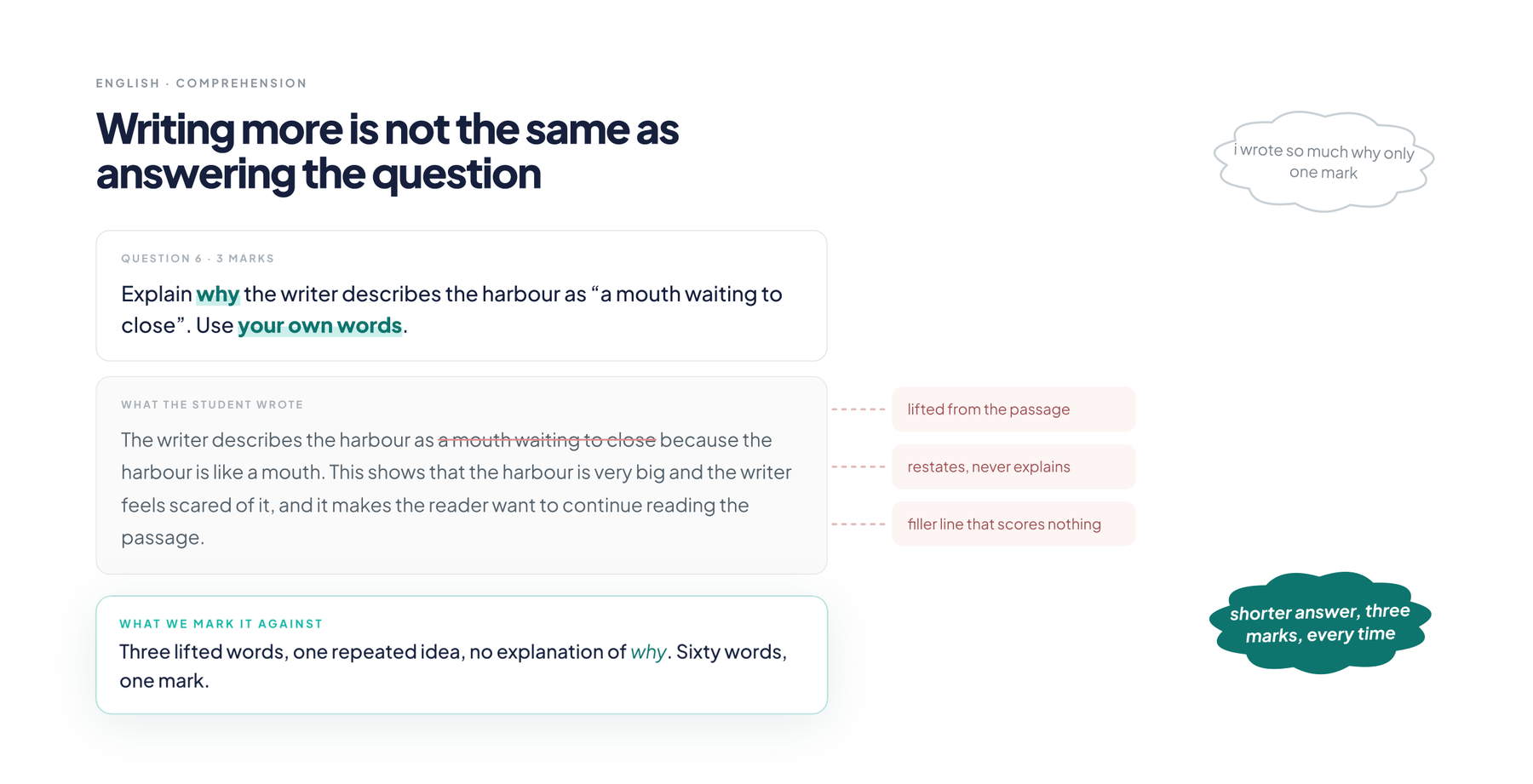
Weak: "The poster uses a picture of a boy looking sad."
Strong: "The image of the boy sitting alone with his head lowered suggests loneliness, which makes readers feel sympathy for students who are excluded and therefore more willing to join the befriending programme."
The formula:
- Point: name the technique or feature.
- Evidence: quote the words in inverted commas, or describe the image precisely.
- Effect: state what the reader thinks, feels or does as a result, and link it back to the purpose of the text.
For image evidence you cannot quote, be forensic. "A photograph of a young person" is vague. "A close-up of a teenager's hands gripping a phone in a darkened room" is evidence.
How to Handle Each Question Type
Purpose and audience questions
Always give two supporting details, not one. If the question says "Explain how you know", the marks are in the evidence, not the label.
Example answer shape: "The target audience is secondary school students. This is shown by the reference to 'after your CCA' and the use of casual slang in the tagline, which would appeal to teenagers rather than adults."
Effectiveness questions
These usually ask which of two features is more effective, or whether the text achieves its aim. Take a clear stand in the first sentence. Do not sit on the fence. Then justify with one developed reason rather than three shallow ones.
"In your own words" questions
If the command word says own words, paraphrase. Lifting a whole phrase from the poster scores zero even when the meaning is right. Change the key content words, keep proper nouns and technical terms.
Common Traps That Cost Marks
- Listing features with no effect. "The poster uses bold red font and a large picture" earns nothing on its own.
- Generic effects. "It catches the reader's attention" is the most overused sentence in Paper 2. Attention for what purpose?
- Ignoring the mark allocation. A two mark question needs two distinct points, cleanly separated.
- Writing an essay. Two to three sentences per mark is plenty. Section A is not where you spend your time.
- Missing the small print. Questions frequently target the least glamorous corner of the visual.
Practise With Real Material
You do not need past papers to train this skill. Every MOE campaign poster, SG Cares flyer, National Library event advert and MRT health notice is a free practice question. Pick one a day, and write two sentences: who is this for, and which single feature works hardest to persuade them. Ten minutes a day for a month, and Section A becomes automatic.
If you would like a tutor who sat these exact papers recently to mark your answers line by line against the mark scheme, come and try a lesson with us. Start a free trial class on WhatsApp and bring a visual text you found tricky.