Section A of O-Level English Paper 2 is only worth 5 marks, but it is the fastest 5 marks on the whole paper if you know exactly what the examiner wants. It is also the section students throw marks away in most often, usually by describing the poster instead of explaining it.
Here is how we teach it at Dojo, based on how we answered these questions ourselves not long ago.
What Section A actually tests
The visual text is usually an advertisement, a public awareness poster, an event flyer or an infographic. The Cambridge and MOE syllabus (1184) wants you to show that you can:
- Identify the purpose of the text and who it is aimed at
- Explain why a specific word, phrase, image or design choice works
- Support every claim with evidence lifted from the text
Notice what is missing. You are not being asked to say what you see. You are being asked to say what it does.
Step 1: Spend 90 seconds reading the poster properly
Before you look at the questions, scan the visual text in this order:
- Headline or tagline. This almost always tells you the purpose.
- The main image. Who is in it? What emotion is on their face? What is the setting?
- Colours and font. Bright and playful, or dark and serious?
- Body text. The smaller paragraphs where the details hide.
- The fine print. Dates, venues, prices, age limits, website, organiser logo. Target audience clues live here.
That last point wins marks constantly. If a poster says "Free entry for students with a valid concession card" or "Suitable for ages 13 to 18", you have your audience evidence handed to you.
Step 2: Use the Feature, Effect, Purpose structure
Every good visual text answer has three moving parts:
Feature (quote or describe it) + Effect (what it makes the reader feel or understand) + Purpose (why the creator wanted that)
A weak answer: "The image shows a boy coughing, which is effective."
A strong answer: "The image of the boy hunched over and coughing, with his face partly obscured by smoke, makes vaping look physically distressing rather than fashionable. This shocks teenage readers out of seeing vaping as harmless, which supports the poster's purpose of discouraging them from starting."
Same observation. The second version earns the mark because it links the feature to a reader response and then to the purpose.
Step 3: Know the four question types
"Who is the intended audience?"
Name the group specifically, then give two different types of evidence. Do not say "young people" and stop. Say "secondary school students in Singapore", then support it with a quotation and a visual detail.
"Explain how the picture and words work together."
Deal with both. Explain the image, explain the words, then explain the link between them. Many students answer only half the question and cap themselves at half the marks.
"Which of these two features is more effective? Explain."
Commit to one. Explain why it works, and briefly say why the other is weaker in comparison. Sitting on the fence scores nothing.
"What does the phrase X suggest?"
This is a language question in disguise. Look for puns, imperatives, rhetorical questions, alliteration, repetition and direct address using "you". Then explain the effect on the reader, not the technique name. Writing "this is alliteration" alone earns zero.
Common mistakes that cost marks
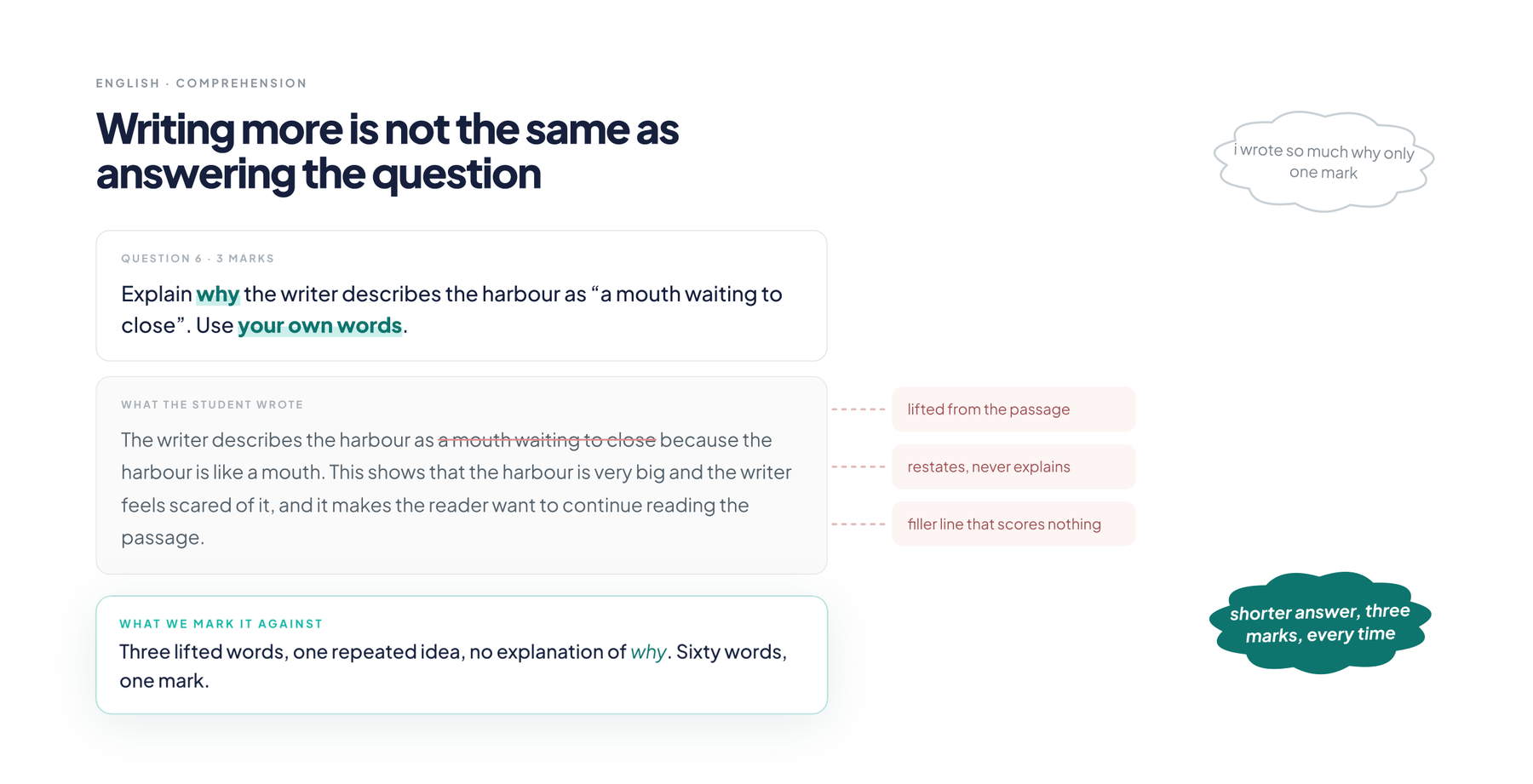
- Listing without explaining. Three features described superficially score less than one feature explained well.
- Copying whole chunks. Quote short and precisely, then comment.
- Ignoring the mark allocation. A 2-mark question needs two distinct points, not one point written twice.
- Writing an essay. Five marks does not deserve twelve minutes. Aim for 8 to 10 minutes total, then move to Section B.
- Vague effect words. "Eye-catching", "attractive" and "interesting" are not effects. Ask yourself: eye-catching so that what happens next?
Useful phrasing to have ready
Bank these sentence starters and slot in your own content:
- "This suggests to the reader that..."
- "The use of the imperative 'Act now' creates a sense of urgency, pressuring readers to..."
- "Addressing the reader directly as 'you' makes the message feel personal, so that readers see the issue as their own responsibility."
- "The contrast between the bright left panel and the dark right panel visually reinforces..."
Build the habit
Practise on real posters. Singapore is full of them: MRT health campaigns, NLB reading drives, SCDF and Health Promotion Board notices. Spend five minutes writing a purpose, audience and one Feature, Effect, Purpose paragraph. Do that twice a week and Section A becomes automatic by prelims.
Want a tutor who recently sat this exact paper to mark your visual text answers line by line? Message us on WhatsApp at https://wa.link/rj3pry to book a free trial class.