The summary question at the end of Paper 2 is the single biggest question on the paper, and it is also the most learnable. Unlike inference questions, where markers accept a range of answers, the summary has a fixed list of content points sitting in the passage waiting to be found. If you know how to hunt for them and how to rewrite them, this becomes the most reliable set of marks in the whole English exam.
Here is the method our tutors used when we sat the paper, broken down into steps you can practise this week.
Understand what you are being marked on
In the current Cambridge O-Level English syllabus, the summary sits in Section C and is marked in two parts: content points and use of own words. Content marks come from identifying the correct ideas. Language marks come from how well you have reworded and organised them into fluent, connected prose within the word limit, usually 80 words including the given opening.
Two things follow from this:
- Copying whole phrases loses language marks even if the idea is right.
- Beautiful writing with only four correct points still scores poorly. Content comes first.
You need both, and you need to allocate about 20 to 25 minutes to earn them.
Step 1: Read the question, not the passage
The question always narrows your search in two ways: by topic and by paragraph range. Something like "Summarise the reasons why urban wildlife populations are increasing and the problems this creates for city residents, using material from paragraphs 3 to 7."
Underline three things:
- The two focus areas, here reasons and problems.
- The paragraph boundaries.
- Any restricting word, such as "only", "urban", "for residents".
Students lose marks every year by lifting perfectly good points that answer the wrong half of the question, or that sit in paragraph 8. Anything outside the range earns nothing.
Step 2: Hunt for points, one line at a time
Work line by line inside the range and number each point in the margin. A good summary passage usually contains 12 to 15 possible points, and you will only fit eight to ten into 80 words. Finding more than you need is the goal, because you can then choose the clearest ones.
What to skip:
- Examples and illustrations, often signalled by "for instance", "such as", "like".
- Statistics and named studies.
- Direct quotations and anecdotes.
- Repetition of an idea you have already noted.
What to grab: general statements, cause and effect language ("because", "as a result", "this leads to"), and contrast words such as "however", which often introduce a fresh point.
Step 3: Paraphrase at the level of the idea
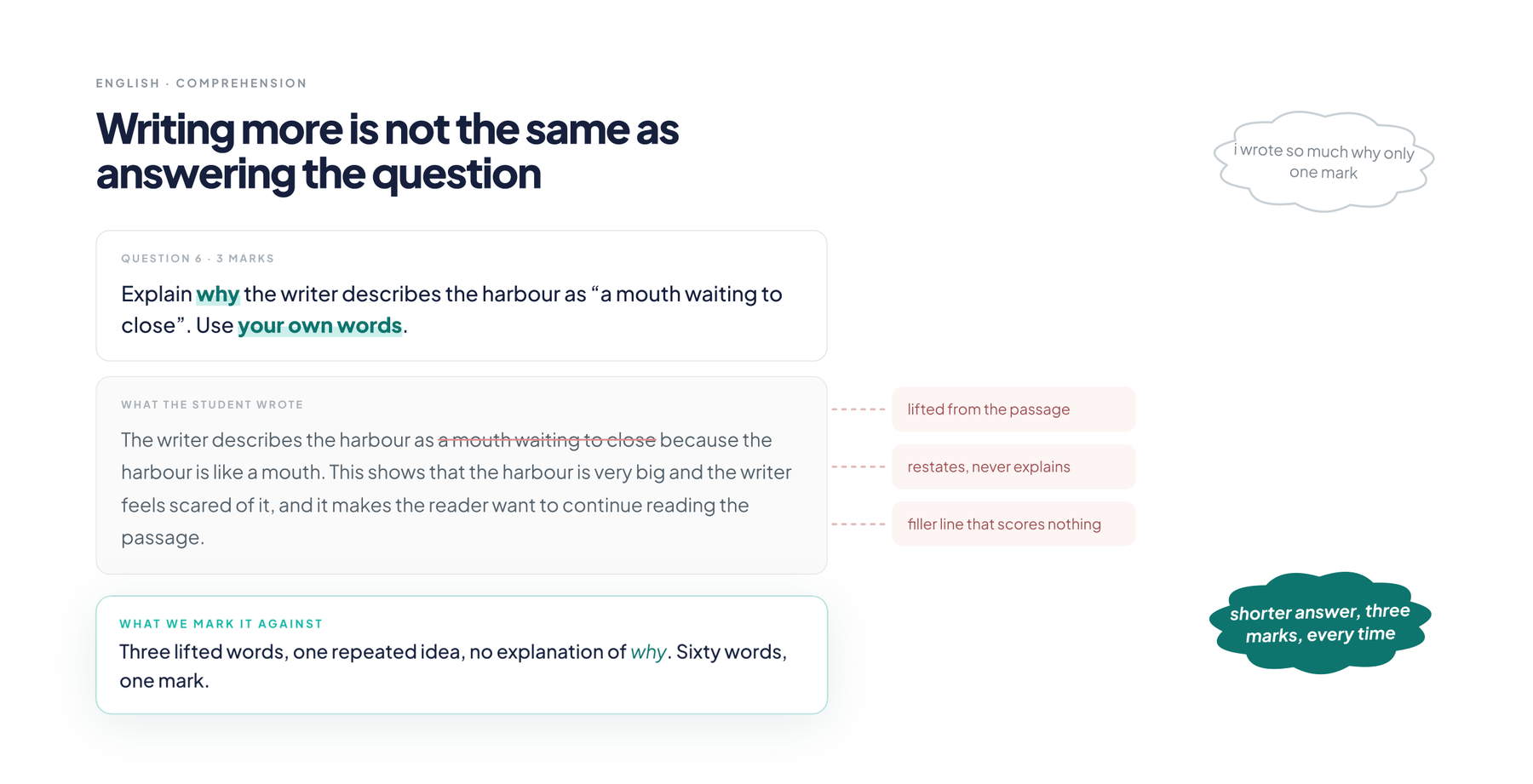
The most common mistake is swapping single words with a thesaurus. Markers can see it, and it usually produces clumsy English.
Instead, cover the line with your finger, say the idea aloud in your own words, then write that down.
Original: "Rising temperatures in built-up areas mean that many species no longer need to migrate southwards in winter."
Weak paraphrase: "Increasing temperatures in constructed areas mean many species no longer must travel southwards in winter."
Strong paraphrase: "Warmer cities let animals stay put all year."
The strong version is seven words instead of eighteen, and it is clearly your own English. Technical terms with no synonym, such as "photosynthesis" or "biodiversity", may be kept as they are.
Step 4: Compress and connect
Now assemble your points into continuous prose, starting from the given opening. Use these compression tricks:
- Combine related points with "and", "while" or "because".
- Turn clauses into phrases: "because they are afraid of predators" becomes "through fear of predators".
- Cut adverbs, hedges and "there is" openings.
- Use short linkers such as "Also", "However", "Consequently" rather than long phrases like "In addition to this".
Write in the third person and the same tense as the passage. Never add your own opinion or conclusion.
Step 5: Count, check, tidy
Count your words honestly and write the total at the end. Markers stop reading at the limit, so a point squeezed in at word 95 earns nothing. Then run a 60 second check:
- Have I answered both halves of the question?
- Have I lifted any phrase of four or more consecutive words?
- Does every sentence make sense on its own, without the passage?
- Have I fixed obvious tense, spelling and subject-verb agreement slips?
Practise with the mark scheme beside you
The fastest way to improve is to do a summary, then mark it against the official content point list and tally exactly which ideas you missed and why. Most students find a pattern within three attempts, usually skipped final paragraphs or ignored contrast markers.
If you would like a tutor who recently sat this paper to mark your summary line by line and show you where the points were hiding, start a free trial class with us on WhatsApp.