Language for effect questions are the ones most students leave half-marked. You know the phrase is "powerful", you can feel that it works, but the words on your answer script do not explain why. Under the Singapore-Cambridge O-Level English (1128) syllabus, Paper 2 Section B always tests this skill, either as a standalone question ("Explain how the writer's use of language in paragraph 4 suggests...") or as the two-mark table question near the end of the paper.
The good news: examiners are looking for a very specific shape of answer. Once you know the shape, these become some of the most reliable marks in the paper.
What the Question Is Actually Asking
A language for effect question is never asking "what happened". It is asking: what does this particular word choice make the reader think, feel or picture, that a plainer word would not?
So every answer has two halves:
- The literal meaning of the word or image (what it normally describes).
- The transferred effect on the subject in the passage (what it therefore suggests about the person, place or situation).
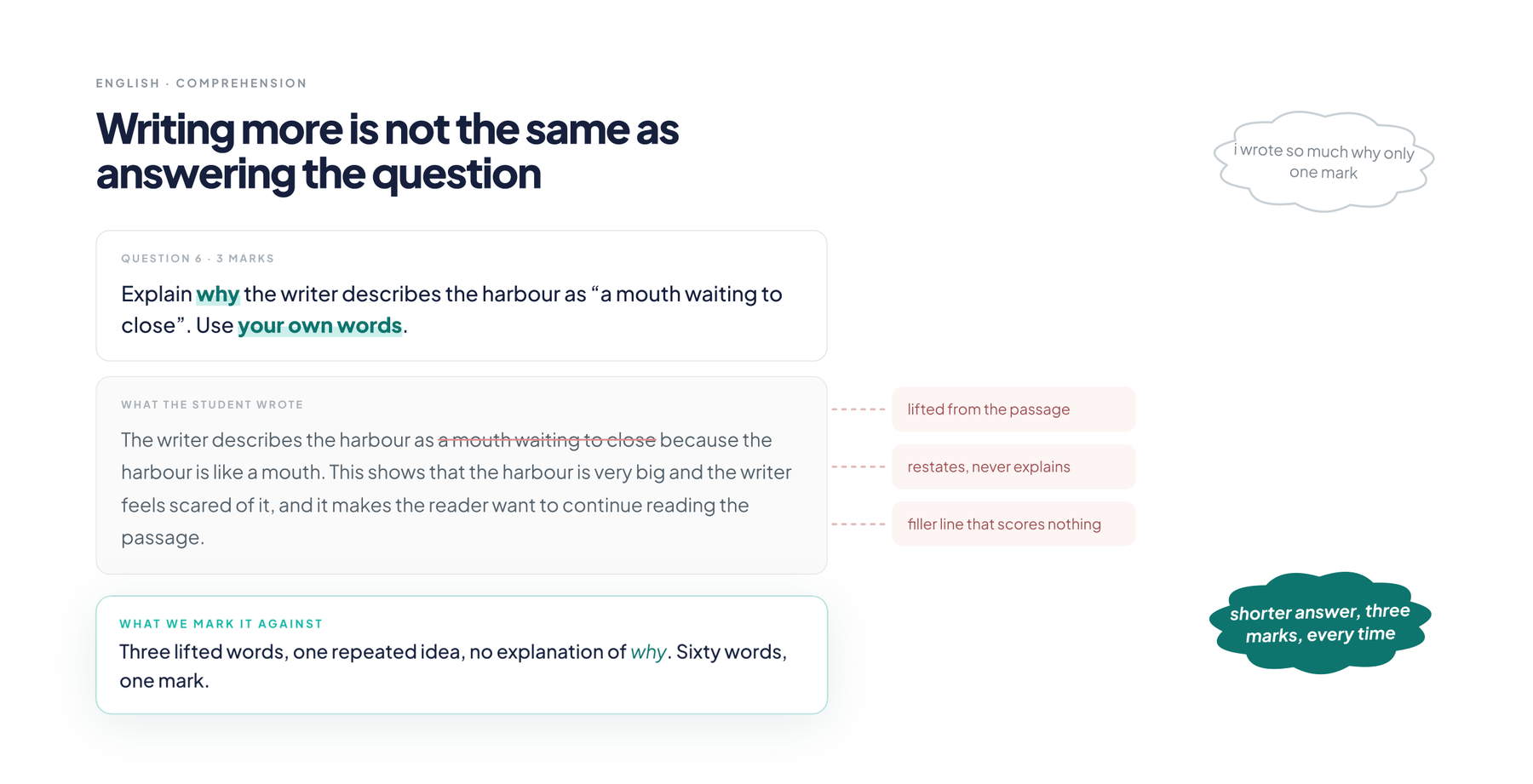
Marks are usually split across those two halves. Students who only do half one get half the marks. Students who write "this creates a vivid image for the reader" get nothing, because that sentence would be true of literally any quotation.
The Four-Step Method
Step 1: Select a Short, Loaded Quotation
Quote words, not lines. If you copy a full sentence, the examiner cannot tell which word you are analysing. Choose verbs, adjectives and images. Aim for one to four words.
Step 2: Name the Literal Sense
Ask yourself: where would this word normally be used? "Devoured" belongs to animals eating. "Skeleton" belongs to bones and death. "Flooded" belongs to water overwhelming a space. Naming the home territory of the word gives you your explanation for free.
Step 3: Transfer It to the Passage
Now apply that literal sense to the subject. If the writer says the crowd "devoured" the news, the animal sense transfers, so the crowd is greedy, uncontrolled, hungry for information rather than thoughtful about it.
Step 4: Add the Reader's Response or Writer's Purpose
Finish with a short clause: this makes the reader feel uneasy, or this emphasises how fragile the village had become. Keep it specific to the passage, never generic.
A Worked Example
Suppose the passage reads:
The old factory stood at the edge of town, its windows blank, its chimneys clawing at a grey sky.
Question: Explain how the writer's use of language suggests the factory is unwelcoming. (2 marks)
Weak answer: "The writer uses descriptive language like 'clawing at a grey sky' which creates a vivid image and makes the factory sound unwelcoming."
That repeats the question and explains nothing.
Strong answer: "The windows are described as 'blank', which normally describes a face with no expression, suggesting the factory is lifeless and gives nothing back to anyone who looks at it. 'Clawing' is an action of an animal attacking with sharp claws, so the chimneys seem aggressive and threatening rather than harmless structures."
Notice the pattern repeating: literal sense, then transferred meaning. No technique labels were even needed.
Do You Need to Name the Technique?
You get no mark for writing "personification" or "metaphor" on its own. Naming the device is optional; explaining it is compulsory. That said, naming it can help you organise the explanation, especially for:
- Personification: the non-human thing is given a human quality, so it feels alive, intentional or menacing.
- Metaphor and simile: two things are compared, so the qualities of one transfer to the other.
- Contrast and juxtaposition: two ideas are placed side by side, so the difference between them is sharpened.
- Repetition and short sentences: rhythm or abruptness creates urgency, finality or emphasis.
The Two-Mark Table Question
Many 1128 papers include a table asking you to select a word or phrase from a given paragraph and explain how it conveys a particular idea. Two rules save marks here:
- Your quotation must come from the paragraph stated. Quoting outside the range scores zero even if the analysis is excellent.
- Do not choose the most obvious literal word. Choose the figurative one. "Very tired" gives you nothing to explain; "hollowed out" gives you a whole answer.
Common Mistakes That Cost Marks
- Paraphrasing instead of explaining. "'Clawing' shows the chimneys are clawing" is a circular answer.
- Feature spotting. Listing devices without effects.
- Over-quoting. Long quotations look like padding and eat your time.
- Generic effect statements. "Makes the reader want to read on" is filler.
- Ignoring the focus of the question. If the question asks how language suggests fear, every point must connect back to fear, not to the setting in general.
How to Practise This Efficiently
Take any past-year Paper 2 passage and underline ten figurative words. For each one, write only two lines: literal sense, transferred meaning. Ten minutes a day builds the instinct faster than doing whole papers, because you are drilling the exact micro-skill the mark scheme rewards.
At Dojo, our tutors recently sat these same papers and mark student answers against real mark-scheme phrasing, so you know precisely where the second mark went missing.
Want feedback on your own Paper 2 answers? Book a 1-to-1 trial with us on WhatsApp and bring a question you found tricky.