Paper 4 is the one paper most students never practise properly. It is worth a real chunk of your English grade, it takes under fifteen minutes in the room, and it is arguably the easiest place to pick up marks if you know what the examiners are listening for. The problem is that almost nobody rehearses it out loud. They read the video stimulus notes, nod, and hope for the best.
Here is how to actually prepare for the Spoken Interaction section, from tutors who sat this exact paper recently.
What Paper 4 is really testing
Under the Cambridge and MOE syllabus for English (1184), Paper 4 has two parts:
- Planned Response. You watch a short video stimulus, get preparation time, and then deliver a spoken response to a specific task and audience.
- Spoken Interaction. You have a discussion with the examiner on a theme related to that video.
Spoken Interaction carries the larger share of the marks, and it is not a memory test. Examiners are assessing whether you can engage in a genuine conversation: respond to what was actually asked, develop your ideas, give reasons and examples, and speak clearly and fluently enough for a listener to follow you easily.
That last point matters. You are not being marked on having a British accent. You are being marked on clarity, pace, appropriate word choice, and whether your ideas hold together.
Use your preparation time properly
Most students spend their preparation time rewriting the Planned Response word for word, then walk into the interaction with nothing.
A better split:
- Spend most of the time on the Planned Response, but jot down key points, not full sentences. Reading off a script sounds flat and examiners notice immediately.
- Spend the last two minutes asking yourself: what will they ask me about this topic? If the video is about food waste, the interaction is likely to move towards personal habits, school canteens, government campaigns, or whether young people care enough.
- Write down two concrete examples from your own life or from Singapore that you could bring in. Examples are what separate a solid answer from a vague one.
A framework that works under pressure
When the examiner asks a question, do not open with "Erm, I think... maybe...". Use a simple structure and let it carry you:
Stand, Support, Situate, Stretch.
- Stand: Give your position in one clear sentence. "I do think schools should take the lead on this."
- Support: Give the reason. "Because habits formed at fifteen tend to stick, and students spend most of their waking hours in school."
- Situate: Give a specific example. "At my school, the recycling bins were placed right beside the canteen exit, and usage went up noticeably once they were visible."
- Stretch: Add a nuance or a counterpoint. "That said, it only works if it is convenient. Ask students to walk two blocks and it collapses."
That is roughly forty to sixty seconds of speech. Long enough to show development, short enough that you are not rambling. Aim for that rhythm on every answer.
Common mistakes that cost marks
- One-line answers. "Yes, I agree, it is very important." That is a dead end. The examiner then has to work to rescue you.
- Endless answers. Speaking for three minutes without a clear point is just as damaging. Land your idea and stop.
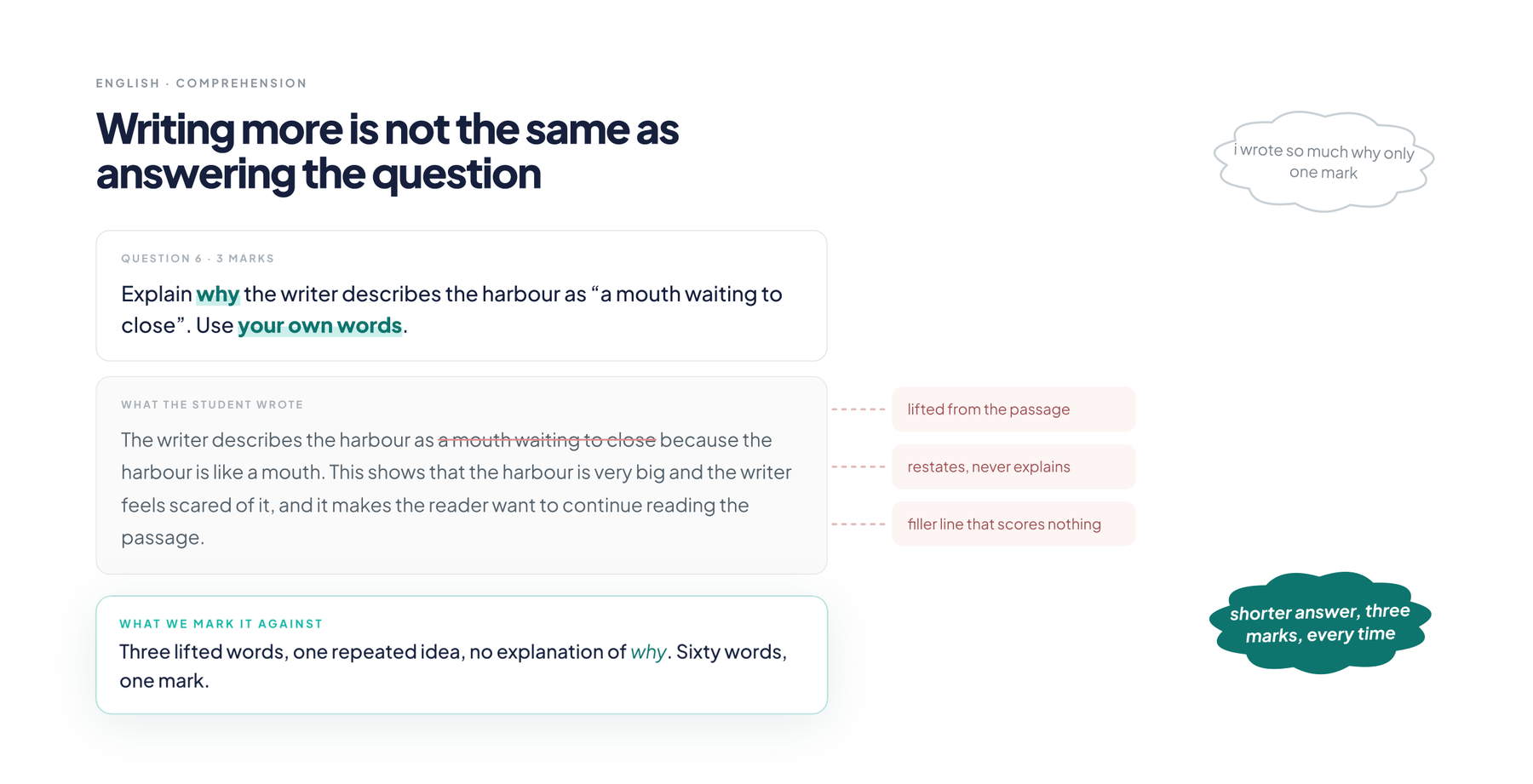
- Ignoring the actual question. If asked how something could be improved, do not explain why it is a problem. Listen to the question word.
- Filler flooding. "Like", "you know", "basically" every five words. Replace fillers with a short pause. A pause sounds thoughtful. "Like" does not.
- Fake formality. Do not force in "plethora" and "myriad". Natural, precise English scores better than decorated English.
How to practise in the four weeks before the exam
- Record yourself. Phone voice memo, one question, sixty seconds. Play it back. You will hear your fillers and your rushing instantly.
- Do the news drill. Take one Straits Times or CNA headline a day. Speak for one minute using Stand, Support, Situate, Stretch. This builds a bank of real examples on housing, environment, technology, youth, and health.
- Read aloud for five minutes daily. Any passage. It fixes pronunciation of word endings, which is where clarity usually breaks down.
- Practise with a partner who interrupts. Get someone to follow up with "Why do you say that?" or "Do you think everyone would agree?". Real interaction is unpredictable, and rehearsing only monologues will not prepare you.
On the day
Walk in, greet the examiner, and sit up. Speak slightly slower than feels natural, because nerves speed everyone up. If you mishear a question, it is perfectly acceptable to say, "Sorry, could you repeat that?". That is far better than answering the wrong thing.
And if you disagree with the examiner's framing, say so politely and explain why. A confident, reasoned view is exactly what this paper rewards.
Want feedback on your actual speaking, not just theory? Message us on WhatsApp at https://wa.link/x755zl to book a 1-to-1 trial and run a live mock oral with one of our tutors.